
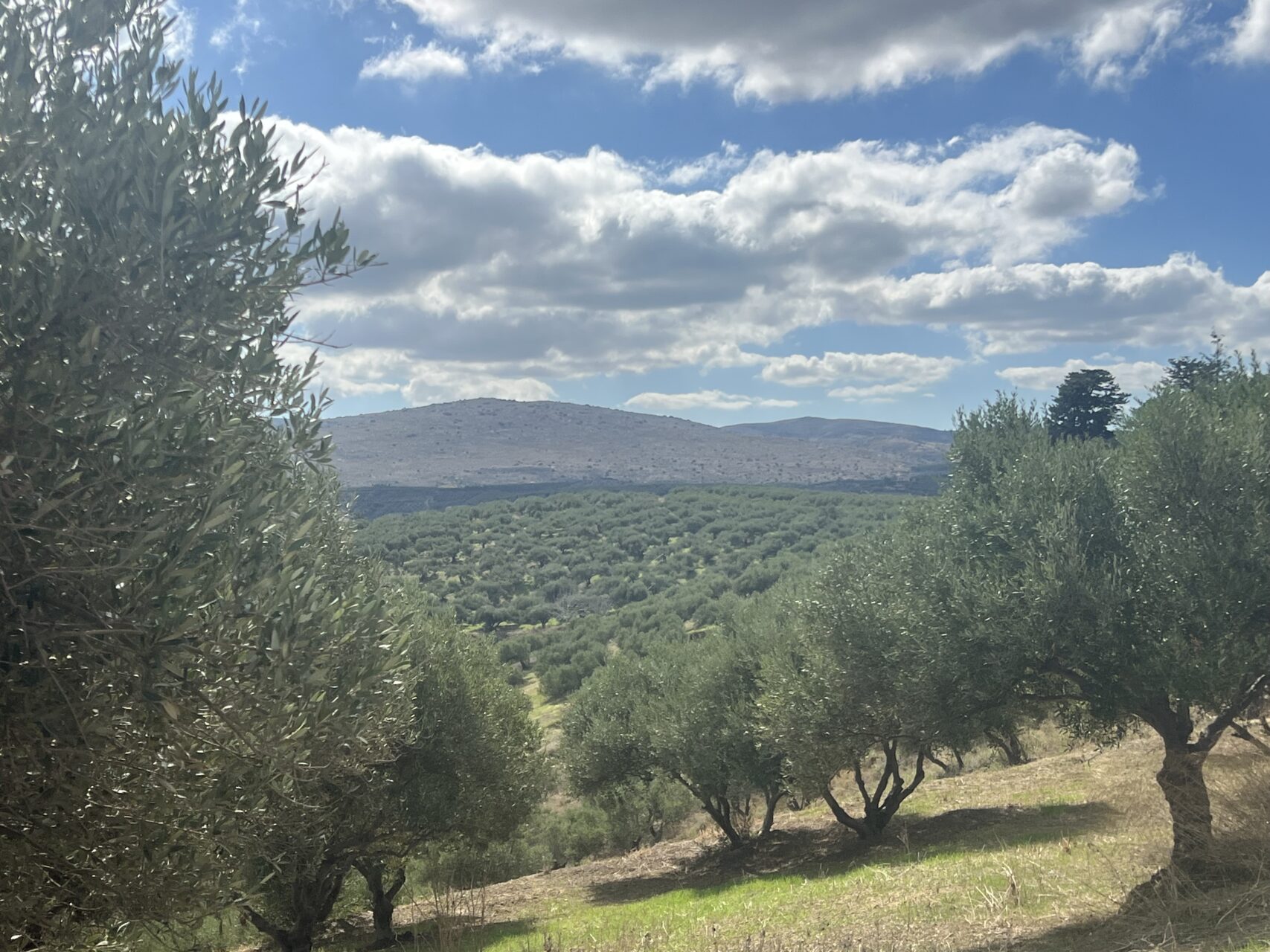
A Year in the Grove.
Twelve Months in the Life of an Ancient Olive Tree
Most people, when they think about an olive tree, think about the harvest.
That is understandable. The harvest is the most visible and most dramatic part of the olive tree’s year. It is when the grove fills with people, when the nets appear beneath the branches, when the olives fall, and the mill begins to work. It is the moment the tree produces something that can be bottled and sent across the world.
But the harvest is roughly two months out of twelve. What happens in the other ten is less visible, less photographed, and rarely described. And it matters both for understanding what the tree is doing and for understanding what olive tree stewardship actually involves across a full year.
This is an account of that full year. Not a celebration of the harvest alone, but an honest record of what an ancient olive tree in Greece does across all four seasons, what the growers are doing around it, what the tree is doing biologically, and what an owner can expect to receive from their tree at each stage of the year.
The timing I describe is approximate. Olive trees respond to their specific microclimate, altitude, exposure, and the particular character of each year’s weather. An early spring can advance the flowering by weeks. A warm autumn can shift the harvest. The figures I give are general tendencies rather than guaranteed dates. The research on olive tree phenology confirms that while the sequence of the cycle has remained more or less consistent across millennia, the precise timing shifts with the conditions of each year. PMC Ecological Calendar of Olea Europaea
January and February. The Rest That Is Not Inactivity
The harvest has ended. The grove is quiet.
From a distance, an ancient olive tree in January looks dormant, the leaves still there, dark grey-green against whatever light the winter provides, but nothing obviously happening. The olives are gone. The activity of the harvest season has ceased.
The tree, however, is not just waiting. Winter is the period during which the olive tree accumulates the chilling hours it needs to flower in spring. The cold temperatures, not extreme cold, but sustained cool nights and mild days of the kind that the Mediterranean winter provides, trigger the biological processes that will produce the flowering in a few months. The olive tree needs winter in order to produce a spring.
January and February are also typically the period for pruning. The growers work through the grove, carefully removing branches that have become unproductive, thinning the canopy to allow light and air to reach the interior of the tree, and shaping the growth for the coming season. Pruning in an ancient olive grove requires genuine knowledge. The tree has been growing for centuries and its structure reflects that history, the way it has divided, the directions it has chosen, the sections that have become dominant. The grower works with that history rather than against it.
The wood that is removed during pruning is not wasted. In many traditional groves, pruned branches are used as firewood, or chipped and composted to return nutrients to the soil. The cycle of the grove includes the cycle of its waste.
For an owner who has visited their tree during harvest, January can feel like a strange absence. The grove that was alive with activity is now quiet. But the quietness is biological necessity, not neglect. The tree is resting in the specific way that trees rest, not sleeping exactly, but accumulating what it needs for what comes next.
March and April. The Return of the Leaves
The first sign of spring in an olive grove is not dramatic.
The olive tree is an evergreen; it does not lose its leaves in winter the way a deciduous tree does, and it does not produce the sudden burst of blossom that marks the arrival of spring in an apple or cherry orchard. The change is more gradual. New growth appears at the tips of the branches. The foliage looks slightly fresher. The tree is extending itself in the small, incremental way that is characteristic of a plant that has been growing very slowly for a very long time.
March is also a period when growers who did not complete their pruning in January and February may finish it. The window for pruning closes as the tree moves toward flowering, because removing active growth too close to the flowering period can reduce the yield.
By April, the olive tree is moving toward the most delicate part of its year. The flower buds are forming, small, green, almost invisible unless you look closely at the branch tips. The olive flower is tiny. Four white petals. Almost nothing by the standards of spring flowers. And yet everything depends on it, because without successful flowering and fruit set, there is no harvest at year’s end.
May and June. The Flowering
The olive tree flowers in late spring, typically sometime between April and June depending on the region and the year. The timing is influenced by temperature during the preceding winter and the specific microclimate of the grove. Thursd — Olive Tree Flower
The flowers themselves are small and pale, clusters of tiny white blossoms that appear along the branches and fill the grove with a faint, dusty scent when the tree is in full flower. Olive pollen is wind-dispersed, which means that flowering season coincides with elevated pollen counts in olive-growing regions, something that anyone with tree pollen allergies will already know.
The flowering period is brief. Olive flowers are open for roughly a week to ten days before they fall. What happens during those few days determines the potential yield of the entire year. Successful pollination leads to fruit set, the development of the small, green proto-olives that will spend the next several months growing toward the size and ripeness that the harvest will eventually collect.
Not every flower becomes a fruit. The olive tree typically sets fruit from a small proportion of its flowers, and some fruit will drop naturally in the early weeks after flowering as the tree adjusts its load to what it can sustain. This is natural and expected. The grove cannot be managed to guarantee a particular yield, only managed to give the tree the best possible conditions for what it does naturally.
This is one of the aspects of olive tree stewardship that I find genuinely interesting to explain to people who are new to it. The tree is not a machine. You cannot set a parameter and guarantee an output. You can care for the soil, prune intelligently, manage the canopy, and time the harvest correctly. Beyond that, the year’s character is the tree’s to determine.
July and August. The Long Summer
The olive fruit spends the summer growing.
By July, the small green olives are visible on the branches, hard, bitter, nothing like the fruit that will eventually be harvested. Over the following weeks and months, they will develop, gradually increasing in size, accumulating the oil that will eventually be extracted at the mill.
The summer in an olive grove in Crete or the Peloponnese is hot and dry. The ancient olive tree is, among other things, extraordinarily well-adapted to these conditions. Its root system, built across centuries, extends deep into the ground in search of moisture. Its small, waxy leaves reduce water loss. It can survive on rainfall that would be insufficient for most crops.
July and August tend to be relatively quiet months in the grove from a management perspective. The main work is monitoring, watching for signs of pest pressure, particularly the olive fruit fly, which can damage the developing fruit. This monitoring is genuinely important. An olive fruit fly infestation, if unaddressed, can compromise the quality of a significant proportion of the harvest. The growers are paying attention throughout the summer, even when no dramatic intervention is required.
For an owner in London or New York or Zurich, July and August can feel like the most distant part of the year, the months when the harvest feels furthest away and the updates from the grove are quietest. The tree, meanwhile, is doing the slow, invisible work of accumulating what will become the oil.
September and October. Veraison and the Approach of Harvest
Something changes in September.
The olives begin to change colour. The technical term is veraison; the same word used for the colour change in grapes, the moment when the fruit moves from green toward violet and eventually, in some varieties, toward black. In the olive, the colour change is one of the key indicators of ripeness and therefore of harvest timing.
For early-harvest, high-polyphenol oil, the growers may begin harvesting in October or even late September, when the fruit is still partially green, and the polyphenol content is at or near its peak. This early harvest produces oil that is more bitter and peppery, with higher concentrations of the phenolic compounds that are associated with the health properties of premium extra virgin olive oil. The yield per tree is lower at early harvest, the fruit contains less oil than it will at full ripeness, but the quality of what is extracted tends to be higher. Discover Greece — Olive Harvest
The decision of when to harvest is one of the most important decisions the grower makes each year, and it is not reducible to a formula. The timing depends on the specific variety, the specific grove, the weather of the year, and what the producer is trying to achieve in terms of flavour profile and oil quality. For Olea Legacy trees, this decision is made by the growers who know the specific trees, the specific grove, and the specific character of each year’s fruit.
November and December. The Harvest
This is the period most people associate with the olive grove. The harvest runs from October through January across Greece’s main growing regions, though the peak period in most groves tends to fall in November and December. Greek Trip Planner
When the harvest begins in each region, and why one grove can be weeks behind another, is set out in When Is the Olive Harvest Season in Greece.
The full account of what the harvest looks, feels, and smells like is in What an Olive Harvest in Greece Really Feels Like. The account here is deliberately brief, because the harvest has already been described in full elsewhere and does not need repeating.
What is worth saying in the context of a full year’s account is this: the harvest is the culmination of twelve months of continuous biological work by the tree, and several months of attentive management by the growers. The olive oil that comes from the mill in November or December is not simply the product of the two months it took to harvest and press. It is the product of the full year, the winter rest and its chilling hours, the spring flowering and its brief vulnerable window, the long summer of slow fruit development, and the careful autumn decision of when to harvest.
Understanding the full year does not change the taste of the oil. But it changes the relationship to it. The bottle that arrives at the owner’s door in winter is the end point of a year-long process that continued in the grove whether or not the owner was thinking about it, which is, in a sense, exactly what a living legacy should do.
The Cycle That Continues
The olive tree does not have an end of year.
When December becomes January, the harvest may still be finishing in some groves. By the time it is complete, the tree is already in the early stages of the rest that will accumulate the chilling hours for the next year’s flowering. The cycle has no stopping point. It simply continues as it has continued, across the same basic sequence, for approximately 2,800 years of documented agricultural practice in the Mediterranean. PMC Ecological Calendar of Olea Europaea
For someone who owns a tree in one of the groves Olea Legacy works with, this continuity is one of the most honest things about the relationship. The tree does not wait for you to pay attention to it. It does not pause when you are busy. It flowers in May regardless of what is happening in London. It accumulates oil through the summer regardless of what the markets are doing. It is ready to harvest in November because the biology of its year has brought it to that point, not because anyone arranged it.
What you own, in stewardship terms, is a place in that continuity. Not control of it. A relationship with it. You receive the oil that the year produced. You follow the tree through the updates and photographs that mark each stage. And if you choose to visit during the blossom months, or the quiet summer, or the harvest itself, you encounter a different tree in a different season from the one you last saw, and the relationship is the richer for it.
The year continues. The tree continues. And the relationship, if it is given the quality of attention it deserves, continues with them.
For those who have not yet visited their tree, What It Feels Like to Stand Beside Your Tree for the First Time describes what that encounter involves. For the full account of the harvest period specifically, What an Olive Harvest in Greece Really Feels Like provides the sensory detail. For those exploring what stewardship involves in practice, the Ownership page provides the full account.
And for the scientific detail on what makes early-harvest olive oil particularly valuable in terms of polyphenol content and quality, High Polyphenol Olive Oil provides the research. For those interested in what happens when the November harvest from one specific ancient tree is pressed, numbered, and presented as a collector edition, How an Ancient Olive Tree in Crete Becomes a Collector Edition covers each stage of that process.
To begin a private conversation about stewardship, reach the Contact page .