
What It Feels Like to Stand Beside Your Tree for the First Time
Before you visit your tree, you own an idea.
You have your stewardship certificate. You have photographs. You can tell people you have an ancient olive tree in Greece, and you can describe what that means in general terms, the harvest, the age, the landscape, the culture that surrounds it.
But there is something you do not yet have.
You do not know your tree.
That distinction, between owning the idea and knowing the tree, is the thing the first visit changes. And it changes it not through any particular dramatic moment, but through the specific, physical, reality of arriving somewhere that has existed for centuries without needing to impress anyone.
The Approach Is Never What You Expect
The first thing worth saying is that you do not arrive at an ancient olive tree the way you arrive at a luxury experience.
There is no designed entrance. No framing. No moment where the landscape arranges itself for the visitor.
You leave the main road and the landscape becomes agricultural. The track is uneven. There are stones underfoot, dry grasses between the trees, low vegetation that has grown wherever it chose to grow. In some places you continue by vehicle; in others, the last part is easier on foot because the ground becomes too irregular to drive on.
The sounds are simple. Wind moving through the leaves. Birds. Insects. Your footsteps on the ground. Sometimes the distant sound of agricultural work somewhere further in the grove.
And there is a particular smell when the ground is warm, dry earth mixed with the vegetation around the trees. Nothing has been perfumed. Nothing has been arranged. The landscape is not performing.
That matters. Because the luxury of this experience is not in the arrival being designed for you. It is in arriving somewhere that has existed without needing to impress anyone.
You see olive trees first. Then more olive trees. And gradually, because you know what you are looking for, you begin scanning for one particular shape. The particular bend of a branch. The way a trunk divides. A hollow on one side. A direction the canopy leans. A branch that seems almost too heavy to be supported by the wood beneath it.
And somewhere ahead, you see it. You recognise it before you reach it.
What the Scale of It Actually Feels Like
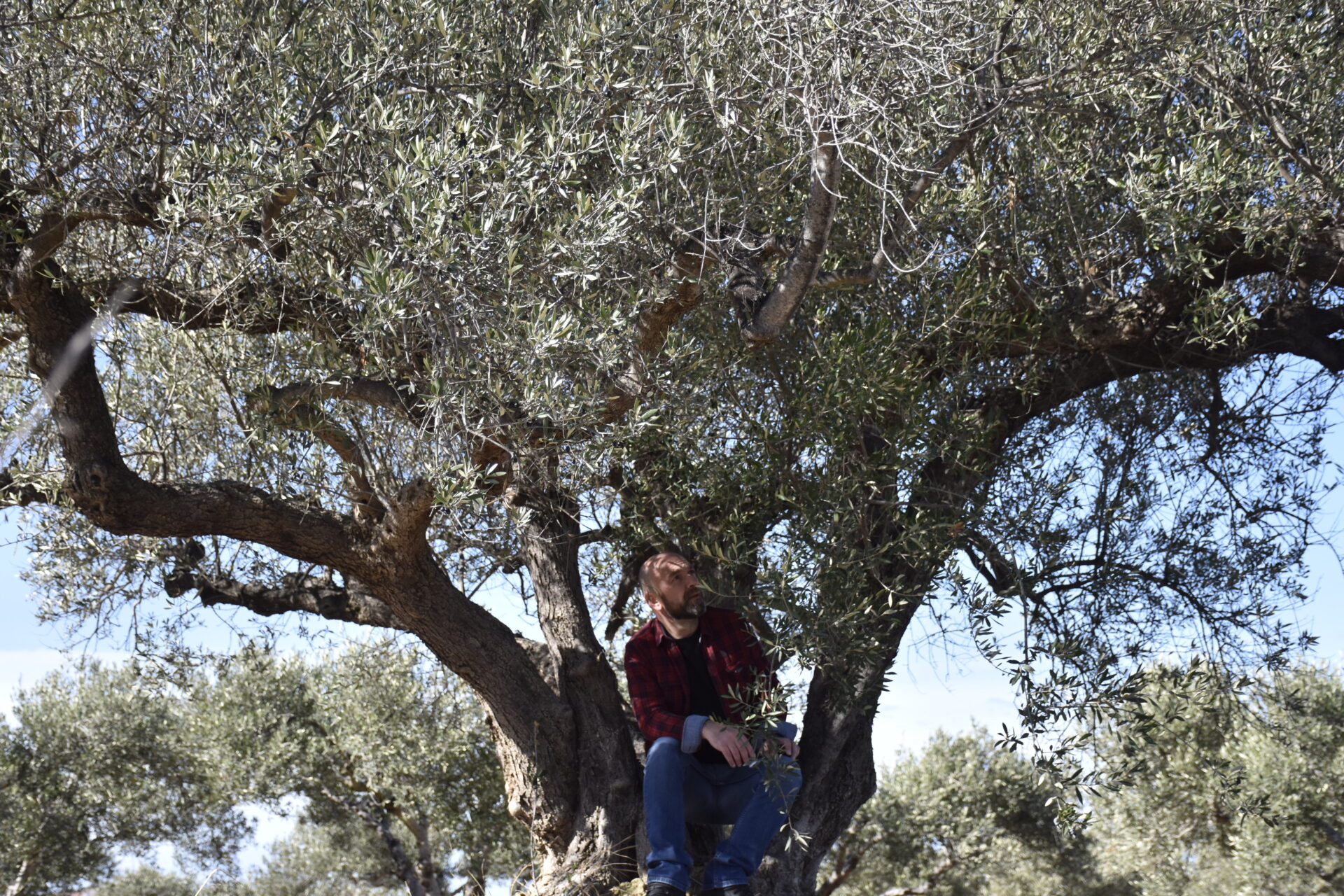
Photographs do not prepare you for the scale of an ancient olive tree. You can look at a photograph of an enormous trunk and understand intellectually that it is old. Standing beside one is a different kind of understanding.
There is a type of tree I keep returning to in my mind when I try to describe this. The trunk is enormous, but not in a clean, symmetrical way. It has twisted and folded over itself for so long that it becomes difficult to understand where the original trunk ends and the later growth begins. At some point it divides into several heavy sections, almost as though the tree made a decision many centuries ago to grow in multiple directions simultaneously.
There is a hollow where the centre has partially disappeared with time. You can look into it and see darkness before the living wood begins again on the other side.
Some of the branches are thick enough to look like separate trunks. Others reach outward at strange angles before turning upward again toward the light.
The bark is not just rough. It has layers, deep cracks, ridges, sections that have weathered away, and places where new growth has appeared directly beside wood that looks almost impossibly old.
And then, at the ends of the branches, there are fresh leaves.
That contradiction is the thing photographs cannot communicate. The tree looks almost sculptural, almost geological, almost like a piece of ancient stone. And yet it is still growing. It is not a monument to something that once lived. It is still living.
The first time you stand beside a tree like this, your sense of scale shifts. Not just the physical scale of the tree, though that is significant, but your sense of time. A person’s normal reference points are years and decades. A career. A marriage. A house. A business. A lifetime. Even a century feels relatively abstract.
But an ancient olive tree makes generations feel concrete. You begin imagining the people who came before. Not specific people, because you do not know who they were. Just people. Someone tending this tree before modern machinery existed. Someone harvesting it by hand. Someone walking past it with a donkey. Families changing. People leaving and returning. Generations coming and going while the tree continued to grow.
And then you realise: you are standing there too. You are not looking backwards. You are standing in the middle of the timeline.
What Happens When You Touch the Bark
Eventually, almost without thinking about it, you reach out.
I have watched this happen enough times to notice that most people do not plan to touch the tree. They simply find themselves doing it.
The first surprise is how the bark feels. It is not uniformly rough. It has layers to it, dry in some places, more textured in others, with deep cracks and ridges and sections where the wood has weathered in ways that feel almost geological beneath the hand. You are touching something that has been exposed to the same sun, wind, and rain for generations.
Your hand does not tell you the tree is ancient. Your mind already knows that. But touching it makes the information physical in a way that knowing it did not.
There is also a quality to the space underneath an old olive tree that I have noticed, and that stays with me. From a distance, an olive grove can seem almost silent. But when you stand beneath an ancient tree, the leaves are constantly moving above you. Not loudly, more like a soft, irregular rustling that comes and goes with the wind. And because the tree is so large, you become aware of the space it creates underneath it. The light changes. Patches of sun and shadow move across the ground. You can stand in one place and watch thousands of small movements above you while the trunk itself seems almost completely still.
That contrast has stayed with me since I first noticed it. The extraordinary stillness of something that has been rooted in the same place for centuries, alongside the constant, small, living movement it produces.
And this is usually when people become quiet.
Not always. Sometimes the first reaction is entirely ordinary.
”It is much bigger than I imagined.”
Or just a pause. A moment where there is nothing useful left to explain, because the explanation is no longer what is needed.
I would not manufacture something more eloquent than that. The moment is not polished. It is personal. And sometimes the most honest thing to say is that someone looked at the tree for a long time without speaking, and then eventually turned and asked when they could bring their family.
That, to me, is the real response. Not a perfectly constructed sentence. The immediate desire to share the experience with someone else.
Before the Visit and After
This is the transformation that I think matters most, and it is quiet enough that you could almost miss it.
Before visiting, an owner can say: ”I have an olive tree in Greece.”
After visiting, that sentence changes completely. Not because the ownership has changed. The certificate is the same. The stewardship arrangement is the same. But the sentence now means something different, because the person saying it knows the tree.
They know which tree. They know the shape of the trunk. They know which direction the branches grow. They know what the bark feels like. They have stood underneath it and watched the leaves moving against the sky.
When they receive photographs from the grove after the visit, those photographs mean something different. They recognise the tree in them. They might notice a particular branch. They might see the landscape behind it and know where they were standing when they first arrived. They might see the tree during harvest, or after pruning, or in spring when it is flowering, and they can locate themselves in relation to it.
They have a reference point. They have been there.
That change is not dramatic. It is quieter and more durable than that. The idea has become a relationship.
What I Think This Experience Offers
There is something particular about leaving an olive tree behind.
You get back into the vehicle. You drive away along the same uneven track. The tree disappears from view.
And unlike almost every other luxury object you can own, you have not taken it with you. Your watch comes with you. Your car comes with you. Your artwork sits in your home. But your tree remains in Greece. Someone else will care for it. The seasons will continue. Rain will come. The tree will flower and set fruit and be harvested. And eventually you will return to it.
There is something in that distance I find genuinely meaningful, and I am aware that this is not how luxury usually works. Most luxury is about possession, about having something with you, in your home, on your person, where you can see it and use it. The value is in the proximity.
Olive tree stewardship works differently. The tree exists exactly where it has always existed. You cannot bring it closer. You can only return to it. And that constraint is not a limitation, it is the thing that makes the relationship specific and honest in a way that possession rarely is.
The idea behind Olea Legacy did not come from a single moment. It came from spending enough time around ancient olive trees to understand that the olive oil is only one part of what makes them extraordinary. The bottle is the result. The tree is the story.
And at some point it became clear that most people will never have the opportunity to experience the relationship with the tree itself. They can buy excellent olive oil. They can visit Greece. They can walk through an olive grove. But they cannot normally say: ”that is my tree.”
That thought is what changed the direction. Not trying to make an olive tree into a luxury product, almost the opposite. Realising that the tree itself is already the thing worth offering. The experience is simply a way of allowing someone to become part of what was already there.
The first visit is when that becomes real.
Not because anything particularly extraordinary happens.
But because afterwards, you know your tree.
For those who want to understand what the harvest experience involves when you return, what the grove feels, sounds, and smells like when the season begins, What an Olive Harvest in Greece Really Feels Like describes it in full. For those exploring what stewardship involves across all four seasons, Oleotourism in Greece provides the seasonal account. For those ready to explore stewardship itself, the Ownership page is the right starting point. And for those who want to understand the broader philosophy behind what is described here, the Philosophy of Living Legacy is where that conversation begins.
To begin a private conversation, the Contact page is your starting point.