
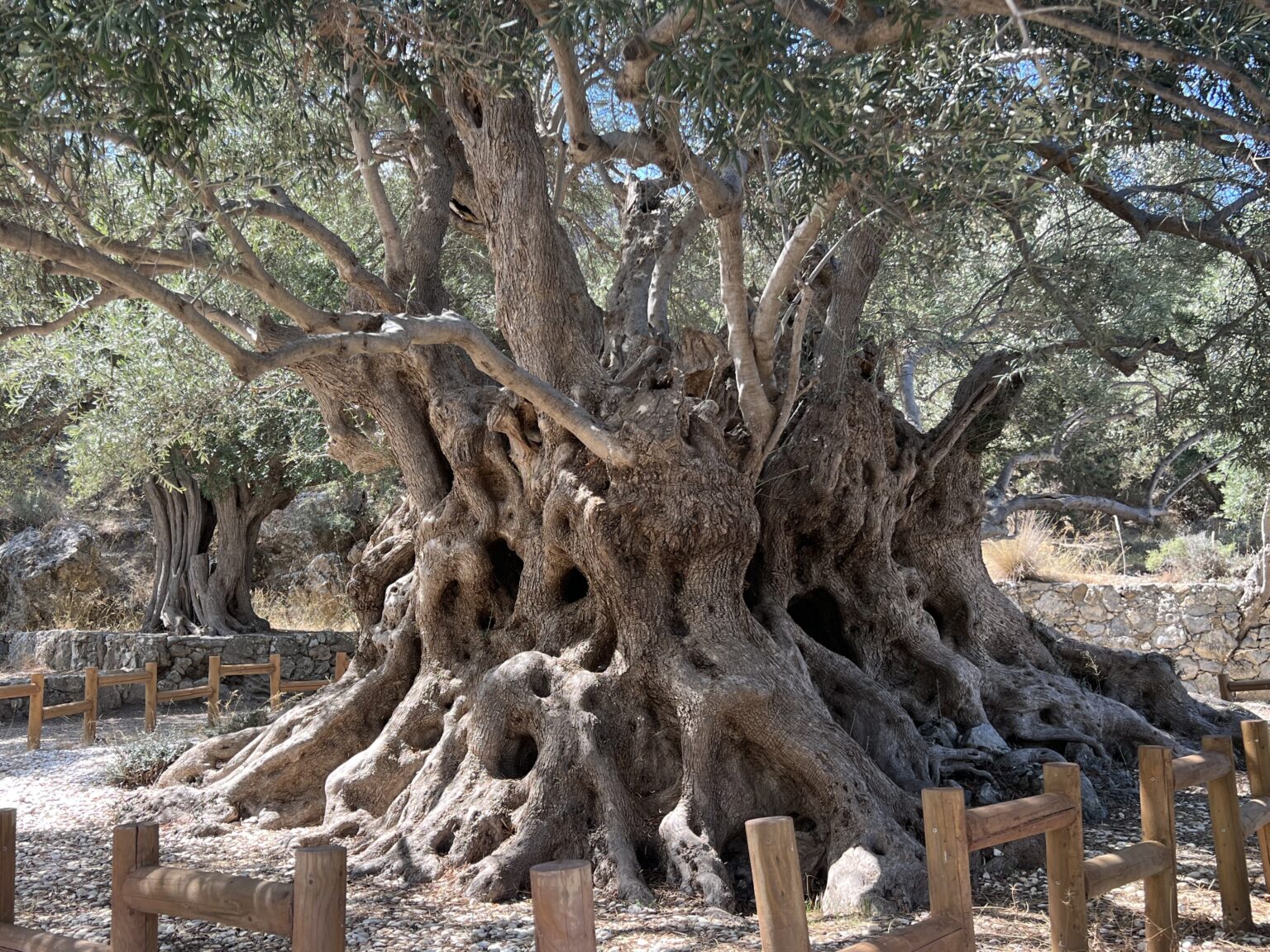
Where to See Ancient Olive Trees in Greece
Most of the ancient olive trees in Greece grow in Crete, and the two most remarkable are open to anyone: the Monumental Olive Tree of Vouves, west of Chania, and the ancient olive of Kavousi, in the east of the island. Ancient olives also grow across the Peloponnese, the Ionian and Aegean islands and the mainland as far north as Halkidiki, and the great olive grove below Delphi lets visitors walk among old trees in one of the most storied landscapes in Greece. Many other ancient trees stand in private groves, where they can be seen only with the owner’s permission.
Where Are the Oldest Olive Trees in Greece?
Crete has the greatest concentration of ancient olive trees in the country. Its long, dry summers and stony hillsides make for slow growth, and slow growth makes for long lives, while the island’s groves have been cultivated without a break for thousands of years. Across Crete, local associations have recognised and marked many old trees as monumental, and a small number have the full legal protection described in How Greece Protects Its Monumental Olive Trees.
Beyond Crete, ancient olives grow wherever the olive has been farmed for centuries: in the Peloponnese, in the Ionian islands, where Corfu was planted with olives in vast numbers under Venetian rule, on several Aegean islands, and on the mainland as far north as Halkidiki. How the character of each of these regions shapes its oil is explored in the olive growing regions of Greece.
The Monumental Olive Tree of Vouves, Crete
The Monumental Olive Tree of Vouves stands in the village of Ano Vouves, about 30 kilometres west of Chania, near Kolymvari. Its trunk measures around 12.5 metres in circumference, hollowed and twisted by time, and the tree still bears fruit. Scientists at the University of Crete estimate the tree to be around 4,000 years old, while tree ring analysis shows it to be at least 2,000, which would make it one of the oldest olive trees in the world. Like every age given for an ancient olive, it is an estimate rather than a laboratory date, for the reasons explained in How to Tell the Age of an Olive Tree. It has been protected as a monument of nature since 1997, and branches from it were woven into the victors’ wreaths at the Athens Olympics in 2004 and the Beijing Olympics in 2008.
Beside the tree, the Olive Tree Museum of Vouves occupies a traditional village house and displays the tools that Cretan families used to plough, prune, harvest and press for generations. The surrounding area is home to ten more monumental olive trees, so it is worth allowing time to explore the lanes around the village rather than stopping only for a photograph.
The Ancient Olive Tree of Kavousi, Crete
The ancient olive of Kavousi grows at Azoria, on the road from Kavousi towards the settlement of Avgos, in the Municipality of Ierapetra in eastern Crete. It is one of the largest olive trees in Greece: at 80 centimetres above the ground, its trunk measures more than 14 metres around, according to Discover Crete. An empirical estimate places its age at around 3,250 years, though like every figure for a tree of this kind it is an estimate rather than a laboratory date.
The tree stands close to the remains of the ancient settlements of Vrontas, Kastro and Azoria, where vessels used for pressing olives have been found, and it was declared a Preserved Monument of Nature in 2019 with guaranteed public access. It is still part of a working grove, which makes a visit quieter and more personal than at Vouves.
The Olive Grove of Amfissa Below Delphi
For a landscape rather than a single tree, the olive grove of Amfissa is unlike anywhere else in Greece. It stretches across hundreds of hectares from the slopes below the sanctuary of Delphi down to the Corinthian Gulf, on ground that has been cultivated since antiquity, and it is strictly protected as part of the Delphic landscape, a UNESCO World Heritage site. The Greek National Tourism Organisation suggests following the old path between Delphi, Chrisso and Kirra, a walk of about two hours past ancient trunks and stone terraces, ideally in the late afternoon, when the light turns gold over the trees.
Ancient Olive Trees in the Peloponnese and Beyond
In the Peloponnese, the village of Apidea in Laconia is home to an ancient olive with a trunk some 14 metres around, estimated to be more than two thousand years old. It has been declared a Preserved Natural Monument, and in October 2025 a plaque was unveiled marking it as the oldest olive tree in the Peloponnese. A short drive away, the Museum of the Olive and Greek Olive Oil in Sparta tells the story of the olive in Greece from prehistory to the present day.
Elsewhere, the old groves of Corfu, the islands of the Aegean and the slopes of Halkidiki all hold trees of great age, though few are signposted. In Athens, an olive still grows beside the Erechtheion on the Acropolis, on the spot where Athena’s sacred tree was said to stand, a story told in The Eternal Tree.
Can You Visit Ancient Olive Trees in Private Groves?
Many of the ancient olive trees of Greece stand in private groves and cannot be visited without the owner’s permission. The trees in the Olea Legacy registry are not signposted, and Yiannis Karapiperis, the founder of Olea Legacy, who has seen these trees in person, confirms that the registry does not publish their locations, so that each steward’s tree remains private. They can still be seen: visitors interested in their story, or in becoming stewards, can contact Olea Legacy to arrange a private tour of routes with ancient olive trees.
How to Visit an Ancient Olive Tree Well
An ancient olive is a living tree, and often a family’s livelihood, so the same courtesy applies wherever it grows. Stay on the paths, avoid climbing on the trunk or standing on the exposed roots, and never take bark, wood or cuttings. Where a tree stands on private land, ask before entering, and if the family is working the grove, a greeting and a little interest are usually rewarded with a story about the tree. Spring brings the flowering in May, while late autumn and early winter bring the harvest, when a visit can become something more, as Olive Picking in Greece describes.
An Ancient Tree of Your Own
The famous trees of Vouves and Kavousi belong, in a sense, to everyone who visits them. For those who would like to see the ancient trees of the Olea Legacy registry for themselves, hear their story and perhaps become their stewards, a private tour can be arranged through the Contact page. Ownership offers the stewardship of a specific ancient olive tree in Greece, with its harvest each year and the freedom to return to it, as set out on Visit Us in Greece. Standing before an ancient olive is a privilege. Knowing one by name is something rarer.