
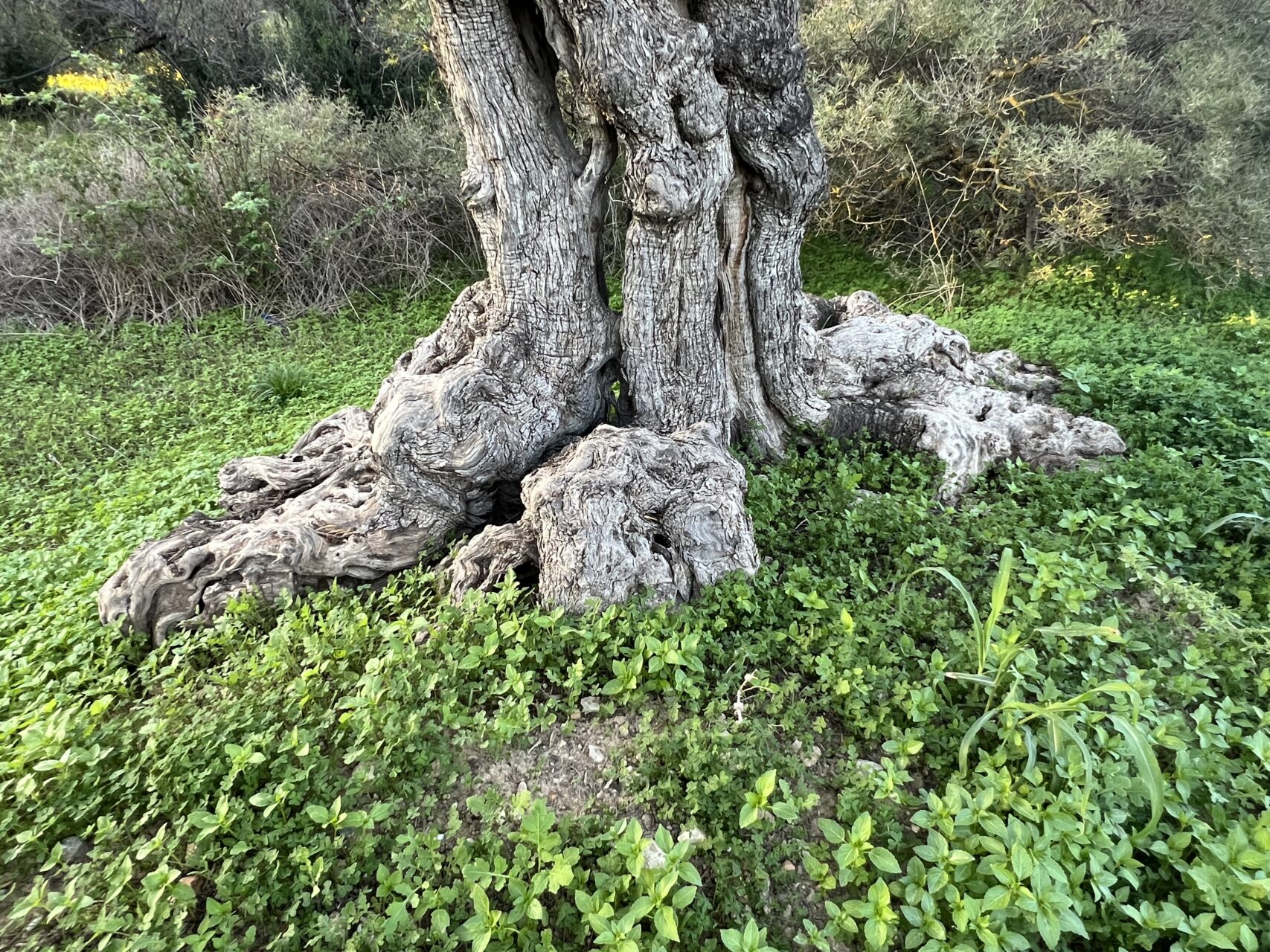
How to Tell the Age of an Olive Tree.
The Methods Behind the Numbers
Most trees keep a record of their own age. Each year adds a ring of wood beneath the bark, and a cut trunk can be read like a ledger, one year at a time. The olive does not keep its accounts so neatly. Its growth rings are often faint, broken or doubled, and in the oldest trees the earliest wood at the centre of the trunk has usually decayed and disappeared altogether. The part of the tree that would hold the answer is precisely the part that time has removed.
This is why the age of an ancient olive tree is always an estimate, and why two estimates for the same tree can sometimes be centuries apart. Understanding how to tell the age of an olive tree is less a matter of finding a single number than of understanding what each method measures, and what it cannot.
Why Olive Trees Are So Difficult to Date
Three things make the olive unusually resistant to dating. The first is its wood. Unlike an oak or a pine, an olive does not reliably lay down one clear ring for each year, and researchers who have tried to count olive rings have found false rings, missing rings and growth that varies sharply from one side of the trunk to the other.
The second is the way the olive ages. As a tree grows very old, its trunk tends to hollow, split and divide, and new wood grows around the edges of what remains. A trunk that appears to be a single body may in fact be several stems that have fused over centuries. The third is the absence of the heartwood. The innermost wood, which would carry the tree’s earliest years, is the wood most likely to have rotted away.
For these reasons, the question of how old an olive tree is has to be approached indirectly. There are two principal ways of doing so.
The Empirical Method: Reading Age From the Trunk
The first approach estimates age from the size of the trunk and the speed at which it grows. The circumference of the trunk is measured at a fixed and recorded height above the ground. From that circumference the radius is calculated, on the reasonable assumption that the trunk is broadly circular. The radius, in millimetres, is then divided by the average amount of wood the tree adds to its radius each year.
Everything depends on that annual figure. A Greek NGO responsible for the sustainable management and recording of the ancient olive trees of Crete uses an average radial growth of 0.75 millimetres a year for areas with sufficient rainfall, and 0.50 millimetres a year for drier ground. The difference matters a great deal. A trunk with a circumference of six metres has a radius of a little under a metre, which gives an age of around 1,270 years at the first rate and around 1,900 years at the second. The same measurement yields two very different trees, depending on how fast that particular tree is believed to have grown.
The best known application of this method is the monumental olive tree of Kavousi, at Azoria in the Ierapetra area of eastern Crete. Its trunk was measured at around eighty centimetres above the ground, and a radial growth rate of approximately 0.75 millimetres a year, attributed to Nikos Michelakis in 2002, gives an estimated age of approximately 3,250 years. That figure has made Kavousi one of the most celebrated of the ancient olive trees of Crete. It is, however, an estimate from the dimensions of the trunk and a chosen growth rate, not a laboratory date.
Olive Tree Carbon Dating
The second approach is scientific. Radiocarbon dating measures the decay of carbon 14 in a sample of wood and gives an independent date for that sample. It is the method behind most of the recent scientific literature on ancient olive trees, and its findings have often been sobering.
A 2017 study of an olive cross section from northern Israel found that a tree believed to be several centuries old contained no surviving wood older than about two hundred years, and warned that age estimates based on trunk size alone can mislead. A 2021 study of monumental olive trees in eastern Spain found that most were between three and five centuries old, well short of the thousand years often claimed for them. And in 2024, radiocarbon dating of the Noah olive trees of Bshaaleh in Lebanon produced the oldest scientifically dated olive tree yet recorded, at around 1,160 years.
Radiocarbon dating has its own limit, though, and it is a significant one in ancient olives. It dates the wood that is sampled, not the tree as a whole. Where the centre of the trunk has rotted away, the oldest surviving wood may be far younger than the tree that once grew around it, and a date taken from that wood describes what remains rather than what has been lost.
Why the Two Methods Can Disagree
The gap between the empirical and the scientific results comes down almost entirely to growth rate. The trees dated by radiocarbon in Israel and Spain were growing at between roughly one and three millimetres a year. Trees growing at that pace reach a large trunk in a few centuries. A tree growing at 0.75 millimetres a year, or at 0.50 millimetres on dry ground, takes several times as long to reach the same size.
The question that decides the answer, then, is not which formula is used but how quickly a particular tree, in its particular place, has actually grown. The olive is extraordinarily sensitive to its surroundings. Rainfall, soil depth, exposure, the variety of the tree and centuries of pruning and harvesting all affect how much wood it adds each year. A growth rate measured in a well watered Spanish grove cannot simply be transferred to a tree on a dry hillside in eastern Crete. The authors of the 2024 Noah study reached a conclusion that points in the same direction: the oldest olive trees are most likely to be found on harsh sites, where growth is slow.
Calibrating Against Trees of Known Age
This is why the NGO’s approach does not rest on a growth rate taken from elsewhere. Its estimates are also checked against the trunks of olive trees of known age found nearby. One reference is an olive tree that had been cut through horizontally at around eighty centimetres, the same height at which trunks are measured, and whose annual rings put its age at around five hundred years. Trees like this show how quickly olives in the same soil and the same climate actually grow, and allow a growth rate to be tested against real wood rather than assumed.
Where radiocarbon dating is not possible, because the centre of the trunk is hollow or no representative sample of wood survives, the NGO regards an empirical estimate grounded in local trees of known age as the most dependable estimate available. It is careful not to overstate it. An empirical estimate cannot be treated as automatically as precise as a laboratory date, and its reliability depends on whether the chosen growth rate truly reflects the tree being measured. But a growth rate tested against trees that grew in the same place, under the same conditions, is a far more grounded basis for an estimate than one carried over from a distant grove.
What an Honest Age Can Tell Us
Every serious figure for an ancient olive tree should therefore be read as an estimate, with the method behind it stated. It is a range rather than a birth certificate, and the word approximately belongs in front of it. That honesty does not diminish the tree. Whether an olive has stood for five centuries or twenty five, it has outlived every person who has ever tended it, and its historical, environmental and cultural value does not depend on the last digit of its age. As the NGO puts it, accuracy in presenting a tree’s age contributes to its responsible recognition and protection.
The age of the tree at the heart of the AION collection, an ancient olive in eastern Crete, has been estimated on these principles: the empirical method, checked against trees of known age in the same area, which places it at approximately 2,500 years. It is presented as an estimate because that is what it is, and its documentation will form part of the provenance record that accompanies each edition. For a closer account of the tree itself and what it means that it still bears fruit, What Does a 2,500 Year Old Olive Tree Look Like provides the detail.