
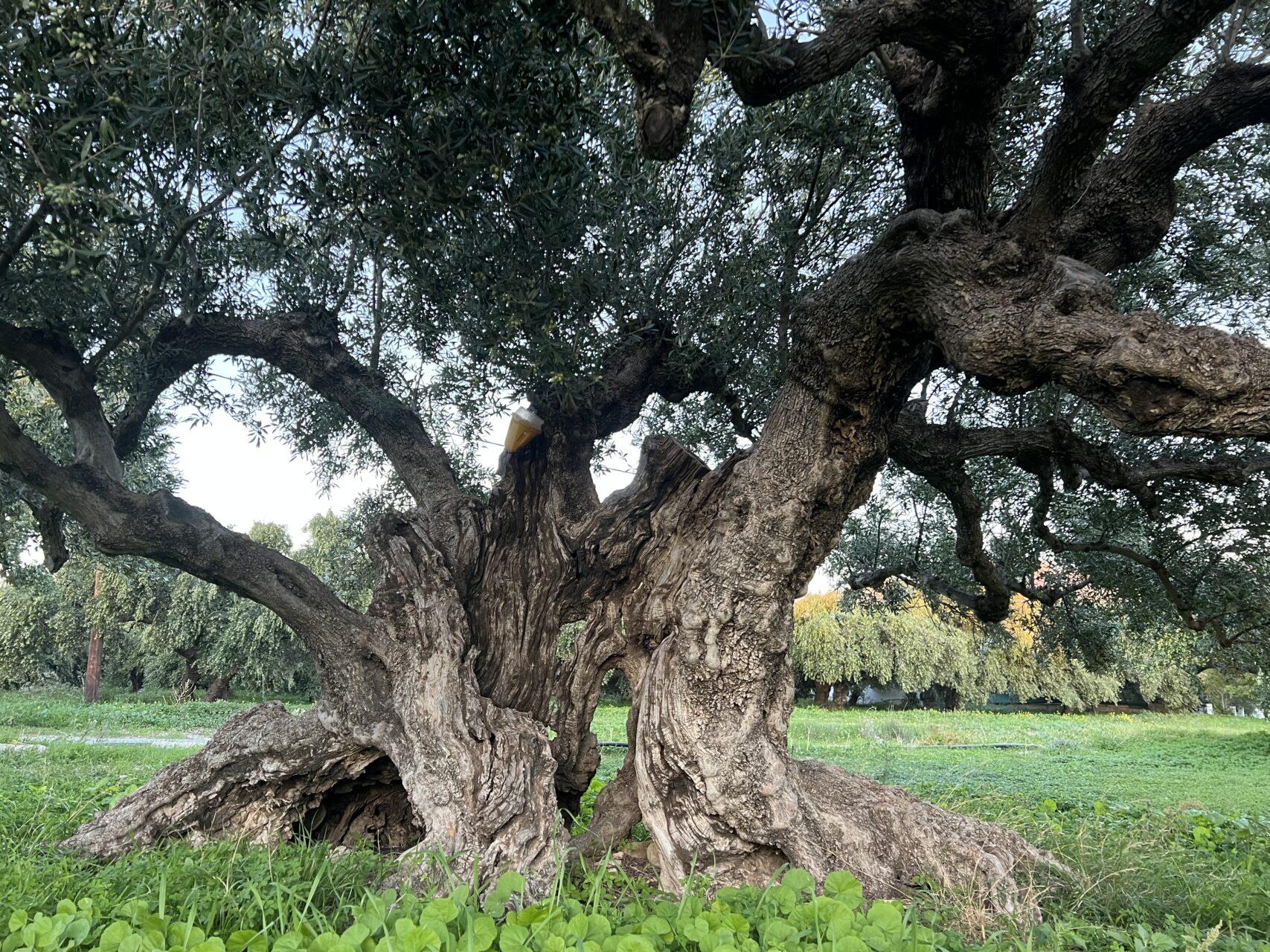
How Greece Protects Its Monumental Olive Trees
Greece is home to some of the oldest living olive trees on earth. They stand in the villages of Crete and the Peloponnese, on the islands of the Aegean and the Ionian, and on hillsides where they have been tended for longer than any written record of the families who tended them. Many are still harvested every autumn. A visitor might reasonably assume that trees of this age and importance are protected as carefully as the ancient monuments that often stand nearby.
The reality is more uneven. A small number of Greece’s monumental olive trees are protected by law. Many more are recognised and recorded without any legal protection at all. And a great many have never been formally identified, which leaves them exposed to the ordinary pressures of farming, building and neglect. Understanding how the ancient olive trees of Greece are protected means understanding the difference between these three conditions.
What Makes an Olive Tree Monumental
There is no single age at which an olive tree becomes monumental. The term describes a tree whose age, size, form or history gives it value beyond the fruit it produces. In practice, the monumental olive trees of Greece tend to share certain features: a trunk of exceptional girth, often hollowed and divided by centuries of growth, a documented or traditional association with a place or event, and an age measured in centuries rather than decades.
Age is the feature most often quoted and the hardest to establish, for reasons explained in How to Tell the Age of an Olive Tree. For the purposes of protection, though, the question is less how old a tree is than whether anyone has recognised it, recorded it and given it a status that the law can enforce.
The Preserved Monument of Nature
The strongest protection available to an individual tree in Greece is designation as a Preserved Monument of Nature. The designation is made under Greek forest legislation, by a decision of the competent forest or regional administration, and is published in the Government Gazette. Once it has been made, the tree is no longer simply private or municipal property. It becomes a protected natural formation, and any work that affects it must first be studied and approved by the authorities.
The designation of the ancient olive of Kavousi, at Azoria in eastern Crete, shows how the process works. The Municipality of Ierapetra submitted a special environmental report supporting the tree’s protection, and in September 2019 the Decentralised Administration of Crete declared it a Preserved Monument of Nature. The decision did not protect the trunk alone. It drew a protected zone around the tree and a small municipal olive grove beside it, guaranteed public access, and required regular checks on the health of the tree and the vegetation around it.
The same status can be granted anywhere in the country. In 2024, the forest authority responsible for the Peloponnese, Western Greece and the Ionian declared an ancient olive known as the Myrtolia, in the village of Apidea in Laconia, a Preserved Monument of Nature. Its trunk measures some fourteen metres around at the base. Day to day protection was entrusted to the local forest service, which issues a formal order setting out what is prohibited around the tree and the penalties for breaking it. The Monumental Olive Tree of Vouves, in western Crete, perhaps the most famous olive in Greece, has held protected status since 1997.
These designations are significant, but they are also rare. Each one requires a formal application, supporting evidence and an administrative decision, and the number of olive trees that have been through that process is small compared with the number that might qualify.
Recognition Without Legal Protection
Between full legal protection and none at all lies a wider layer of recognition. In Crete, the Association of Olive Oil Producing Municipalities has declared a large number of ancient trees monumental, and many of them are now marked and visited. Recognition of this kind matters. It draws attention to a tree, encourages its owners and neighbours to value it, and often makes it part of the life of a village. It does not, however, carry the force of law. A tree that has been declared monumental by an association is honoured, but it is not protected in the way that a Preserved Monument of Nature is.
Recording sits alongside recognition. Since the end of the 2000s, cultural associations, researchers and volunteers have worked to locate, measure and photograph the ancient trees of Crete, and a Greek NGO now carries out the sustainable management and recording of the island’s ancient olive trees. Elsewhere in Greece the work is less advanced, and many monumental trees in the Peloponnese and on the islands have never been formally documented. Recording does not protect a tree by itself, but it is the first step. A tree that has been measured, photographed and placed on a record can be the subject of an application for protection. A tree that nobody has recorded cannot.
What Still Threatens the Oldest Trees
The pressures on unprotected trees are rarely dramatic. Few ancient olives are lost to a single act of destruction. Most disappear gradually, through decisions that seem reasonable at the time. Old trees produce less fruit than young ones and are harder to harvest. In the 1990s, agricultural subsidies encouraged the replacement of old trees with more productive varieties, and many were cut down for firewood. Road building, new vineyards and greenhouses have taken others, and trees that their owners did not recognise as exceptional have simply been neglected until they died.
The loss of an ancient olive is not only the loss of a tree. It is the loss of a living link to centuries of cultivation, and of genetic material that may exist nowhere else. Once such a tree has gone, nothing can replace it, because nothing can reproduce the centuries that made it.
Why Recording and Stewardship Matter Now
The protection of Greece’s monumental olive trees will not come from the law alone. Formal designations will continue, one decision at a time, but most ancient trees will depend for their survival on the people who own them, tend them and choose to value them. That is why recording and stewardship matter as much as legislation. A tree that is known, measured and cared for has a future that an unrecorded tree does not.
This is the principle behind Olea Legacy’s work. Every tree in its care is individually tagged and located, its history and condition are documented, and its cultivation is entrusted to the growers who know it best. Olea Legacy has also been cataloguing ancient olive trees in partnership with a cooperative in Crete, as part of a wider effort to record the ancient olive trees of Greece. Stewardship of this kind does not replace the protection of the law, but it gives each tree something the law cannot: a person who knows it by name and has a reason to see it endure. The idea of heritage as something living rather than preserved is explored further in What Is Living Heritage?, and the way stewardship is structured is set out on the Ownership page.