Chronos, Kairos, Aion.
The Three Greek Words for Time
English asks a single word to carry almost everything we mean by time. The hour on a clock, the right moment to speak, the length of a life and the span of an age all share the same four letters. Ancient Greek was more exact. It kept separate words for separate experiences of time, and three Greek words for time in particular, chronos, kairos and aion, have survived into the way philosophers, theologians and artists still think about it today.
Of the three, chronos and kairos are the better known. They appear in books on leadership and in sermons, usually as a pair, one standing for the clock and the other for the opportunity. Aion is the oldest of the three and the least understood. It is also the one that says the most about how the Greeks understood a life, and how they imagined something that does not end.
Chronos, the Time That Is Counted
Chronos is time as sequence. It is the succession of one moment after another, the time that can be divided, measured and added up. It gives us chronology, chronicle and chronometer, and it describes the time in which events are dated and placed in order.
The Greeks understood that this kind of time has an unforgiving quality. Later writers often blended Chronos with Kronos, the Titan who devoured his own children, and the confusion lasted because it felt true. Counted time consumes what it contains. Every hour that passes is an hour that has been used, and no quantity of chronos can be stored or given back.
Kairos, the Moment That Must Be Taken
Kairos is not a quantity of time at all. It is a quality: the right moment, the opening that appears once and has to be recognised before it closes. A physician waiting for the turning point of a fever, an orator choosing when to speak and a sailor reading the wind all depend on kairos rather than chronos.
The Greeks gave this idea one of the most memorable images in their art. The sculptor Lysippos of Sicyon made a bronze figure of Kairos, now lost, which the poet Posidippus described in an epigram. The figure runs on tiptoe on winged feet and holds a razor. He wears a long lock of hair over his forehead, while the back of his head is bald. The meaning is plain. The moment can be seized as it approaches, and once it has passed there is nothing left to hold.
Aion, the Time That Holds a Whole Life
Look up the aion meaning in a modern dictionary and the answer is usually eternity. That is where the word arrived, not where it began. In the earliest Greek poetry, aion is not an abstraction but life itself. In the Iliad, Priam pleads with Hector not to face Achilles, warning that he will be robbed of his own sweet aion, and Andromache, mourning Hector, says that her husband has been lost from aion while still young. In the Homeric Hymn to Hermes, the same word names the marrow of a tortoise, as though it were the very seat of life. Aion describes life not as a sequence of days but as a single whole, the complete span of one existence held together.
From that root, the meaning widened. Aion came to mean a lifetime, then a generation, then an age, and finally the whole extent of time itself. Each step keeps the original sense intact. Aion is always time taken as a whole, the complete span of something rather than any one of its moments. This is why the word has been translated so variously, as life, age, era and eternity, and why each translation captures only part of it.
How Aion Came to Mean Eternity
Three thinkers carried aion from the span of a life to the span of everything.
Heraclitus of Ephesus, writing around 500 BC, left one of the most enigmatic sentences in Greek philosophy. In the fragment that modern scholars number B52, he says that aion is a child at play, moving pieces on a board, and that the kingdom belongs to the child. The image resists any single reading. What it does make clear is that aion stands at the centre of the order of the world, and that this order is pictured not as a machine but as a game that is always being played again.
Aristotle, in On the Heavens, offered an explanation of the word itself, deriving aion from aei on, that which always is. For Aristotle, the time that encloses the life of each living thing is called its aion, and the aion of the heavens as a whole is a span without any limit at all.
Plato gave the idea its most lasting form. In the Timaeus, he describes the maker of the world wishing to bring it as close as possible to its eternal model, and so resolving to make a moving image of eternity. That moving image, Plato says, is what we call time. The word he uses for eternity is aion. In this account, chronos is not the opposite of aion but its reflection, the restless, counted copy of something whole and unchanging.
Aion, the Greek God of Eternity
By the Hellenistic and Roman periods, Aion had become a figure in his own right, a god of unbounded and cyclical time, distinct from the onward time of Chronos. Artists gave him a consistent image. He usually appears as a man standing within a great ring decorated with the signs of the zodiac, holding the turning of the years in place.
The finest surviving example is a floor mosaic from a Roman villa at Sentinum, near modern Sassoferrato in central Italy. It was made in the first half of the third century AD and is now in the Glyptothek in Munich. Aion stands inside the zodiac wheel. Below him reclines the earth goddess Tellus, surrounded by four children who represent the seasons. The composition says in a single image what the philosophers had argued in words. The seasons turn, the years pass and the counted time of the world moves on, but all of it is held inside a larger circle that does not move.
Chronos vs Kairos, and Where Aion Stands
Set side by side, the three words describe three relationships with time rather than three units of it. Chronos is time that is spent. Kairos is time that is seized. Aion is time that is held, the whole span of something understood at once rather than counted out piece by piece.
The difference between chronos and kairos is the difference between duration and occasion, and it is discussed so often because both belong to ordinary experience. Aion is rarer, because ordinary experience seldom offers it. A human life is lived in chronos and marked by moments of kairos. Only from a distance, looking at a life as a whole or at something that has outlasted many lives, does aion come into view.
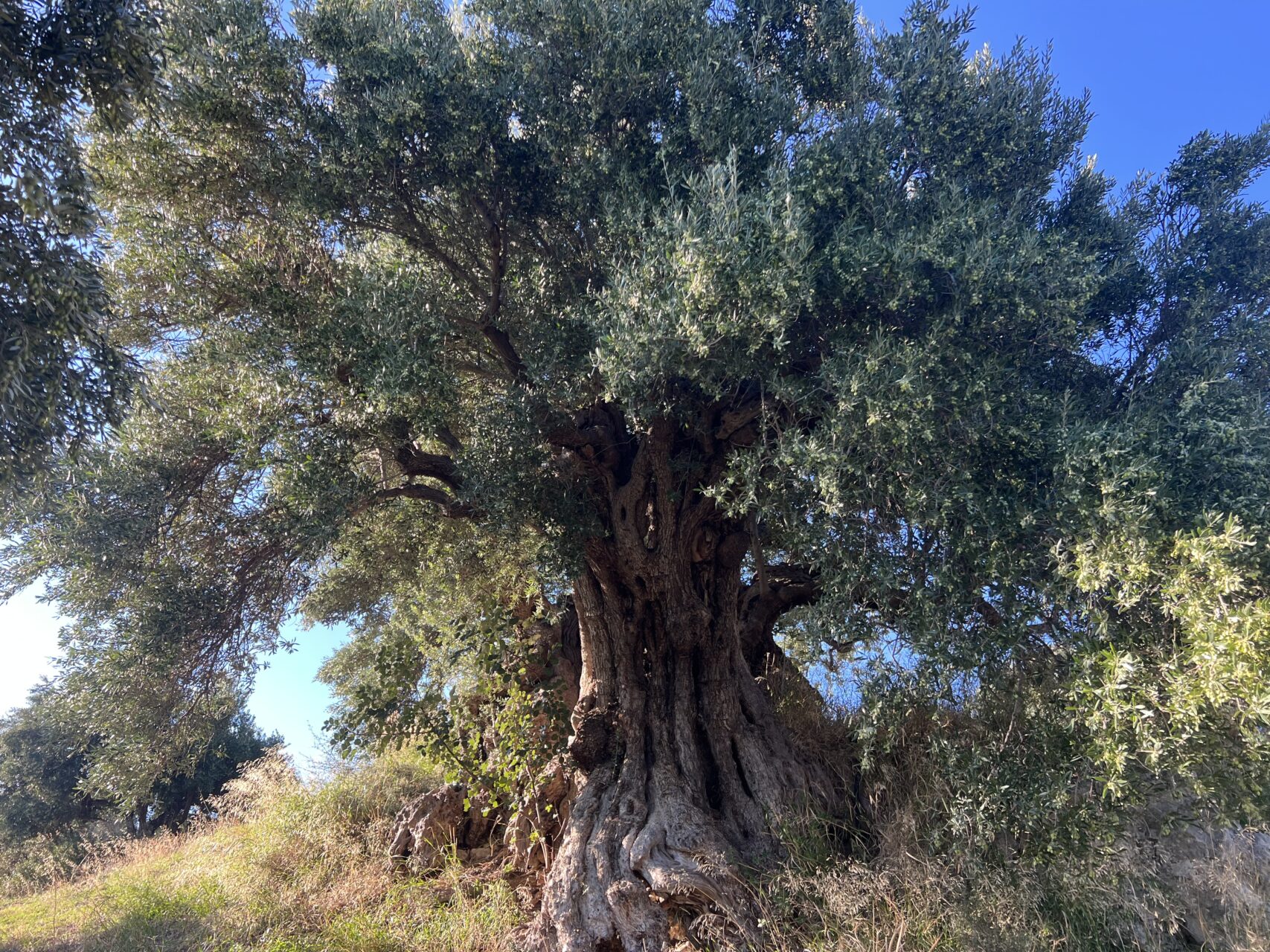
In the natural world, few things offer that view as directly as a tree that has borne fruit across many human lifetimes. No single person who tends such a tree ever sees more than a fraction of its life, so its life can never be experienced as a sequence by anyone. It can only be understood whole. The olive held a central place in the Greek imagination for reasons explored in Olive Tree Symbolism in Ancient Greece and Beyond, and an olive of great age is perhaps the clearest example in nature of aion made visible.
Why a Collection Is Named for Aion
When Olea Legacy chose a name for a collection drawn from a single ancient tree in eastern Crete, chronos would have described the age of the tree, and kairos the single harvest. Neither word was large enough. The tree is estimated to be approximately 2,500 years old. It was already growing while the ideas of Heraclitus were still new, and it was a young tree when Plato wrote the Timaeus. Its life is not a sequence of years so much as one continuous span that has held every one of them.
That is what aion meant to the Greeks, long before it meant eternity. It meant a life taken whole. Each of the twenty editions of the AION collection will carry one season from that life, gathered this November and revealed in December. The season belongs to chronos, and the decision to gather it belongs to kairos. The name belongs to the tree.
For a closer account of the tree itself, and of what it means that it still bears fruit, What Does a 2,500 Year Old Olive Tree Look Like provides the detail.