
What Single-Tree Olive Oil Provenance Means
The word provenance carries weight in almost every serious field of collecting. In the art world, it is the documented chain of ownership that distinguishes a genuine work from a copy. In wine, it is the unbroken record of storage and handling that allows a bottle to be trusted rather than merely purchased. In furniture and antiques, it is what separates a piece with a verifiable history from one with a plausible story.
In olive oil, provenance has traditionally meant something far less precise. A bottle labelled with a country of origin, a region, or even an estate gives the buyer a category, not a chain. It answers the question of roughly where, but not who, not which trees, not which harvest, and not whether the oil in the bottle corresponds in any verifiable sense to the place named on the label.
This gap between what provenance is claimed to mean and what it actually requires is where the single-tree format becomes not a marketing distinction but a structural one.
What provenance requires
Provenance is not the same as origin. Origin tells you where something came from in a general sense. Provenance tells you how you know that, and what evidence exists to support the claim.
A wine from Burgundy carries a geographic designation, not a provenance guarantee. The appellation system tells you the wine came from within a defined area, but it does not tell you which parcel, which vines, which barrels, or whether any of those details were recorded and held against the final bottle in your hand. The finest examples go further. Domaine de la Romanée-Conti is a monopole: the entire vineyard is owned by one entity, every bottle comes from one specific plot, and that specificity is precisely what makes it among the most sought-after wines in the world. Collectors are not paying for Burgundy. They are paying for the verifiability of a single source.
The distinction between origin and provenance is the distinction between a label and a record.
In olive oil, this distinction has rarely been made clearly, because until recently the conditions that allow genuine provenance did not exist in commercially available oil. Even single-estate oils, which are honest and often excellent, blend the fruit of many trees, sometimes thousands, across a property of dozens of hectares. The estate is the unit of origin. No individual tree within it is traceable to the oil in any specific bottle. The problem runs deeper still: a study by researchers at the University of Bari and Italy’s food fraud inspectorate found that for a significant number of commercial extra virgin olive oils, the declared geographical origin was inconsistent with the DNA of the olive varieties detected in the oil itself. What the label said and what the oil contained were not the same thing.
Why single-tree provenance is structurally different
When olive oil comes from one tree, the chain of custody condenses to a point that is genuinely verifiable rather than administratively certified.
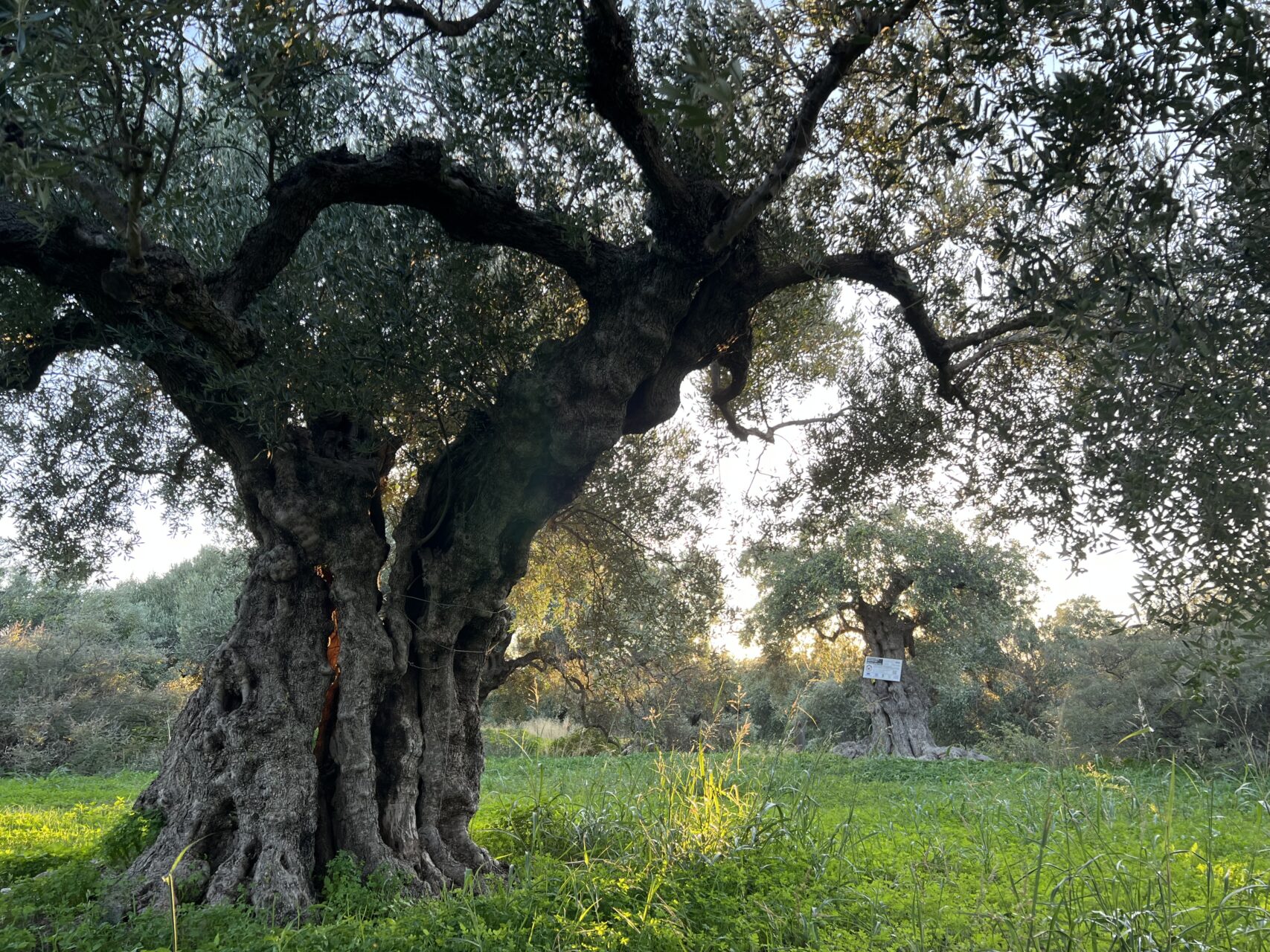
There is one organism. Its location is fixed and known. Its fruit is harvested separately, kept separate through the pressing, and filled into a numbered set of vessels whose total volume corresponds to what that one tree produced in that one harvest. The person who holds bottle seven of twenty holds something that can be traced, without inference or approximation, to a specific living tree in a specific place in a specific year.
This is not a refinement of estate provenance. It is a different category of claim. Estate provenance is a designation. Single-tree provenance is a record.
The distinction matters because it determines what the person holding the oil actually knows. With a regional designation, you know that the oil came from somewhere within a defined boundary. With an estate designation, you know it came from somewhere on a specific property. With a single-tree edition, you know it came from one organism, in one season, pressed from fruit picked on one set of days and kept entirely separate through every subsequent step.
That degree of specificity cannot be achieved by intention alone. It requires that the production volume be small enough that keeping the oil separate is physically possible, that the number of editions be determined by what the tree actually produced rather than by a commercial target, and that the chain of handling be short enough that no step exists at which the oil could be combined with another source without detection.
At scale, these conditions become impossible to maintain. A producer working with hundreds of trees cannot physically hold each tree’s oil separately through the full production process. Genuine single-tree provenance is therefore not a premium tier of a larger operation. It is structurally only possible at the smallest scale, which means it is structurally rare.
What the oil carries that the label cannot say
Olive oil, unlike wine, does not age into greater complexity. It is perishable, and its finest qualities are most present in the months immediately after pressing. What the person who holds a single-tree edition is acquiring is therefore not an asset in the sense that a case of first growth Bordeaux is an asset. It is something closer to a record of a specific moment.
The tree that produced the oil in November of a given year has a history that extends back centuries. Its root system has shaped the soil chemistry around it across multiple human lifetimes. Its particular expression in any one harvest reflects that year’s rainfall, temperature, and the exact timing of the picking decision. None of this can be replicated. The following November will produce a different oil from the same tree, because the tree will have lived another year, and the season will have been different.
What genuine provenance gives the person who holds it is not simply the assurance that the oil is good, or that it came from a respectable place. It is the knowledge that this object is unrepeatable in the most literal sense: that it is the product of one organism in one moment, and that no version of it will ever exist again.
That kind of knowledge is different in kind, not only in degree, from what a regional designation or even an estate label provides.
What this means for Olea Legacy
The AION collection was conceived around an ancient olive tree in eastern Crete that has been producing fruit for longer than most European institutions have existed. The olive oil it yields each November is pressed separately, held separately, and numbered according to what the tree actually produced, not according to a commercial volume target. Twenty editions, because twenty was what the harvest allowed.
The provenance claim attached to each edition is not a marketing position. It is a structural consequence of how the oil is made. The chain from tree to bottle is short enough, and the volume small enough, that the claim can be followed rather than assumed.
For those who want to understand how that process unfolds across a full harvest cycle, from the months of stewardship before picking through to the final numbered vessel, the account is here: How an Ancient Olive Tree in Crete Becomes a Collector Edition.