The Olive Tree Symbolism in Ancient Greece and Beyond
The olive tree’s symbolism has shaped culture for thousands of years, and while its roots lie firmly in ancient Greece, its branches have reached across the Mediterranean and far beyond. What makes it worth examining closely is not simply that it recurs everywhere, but how consistently the same handful of meanings, peace, wisdom, prosperity and resilience, survive the journey from one culture to the next.
The full story of Athena’s gift to Athens, and of the ancient trees still standing near the Acropolis today, is told in the eternal tree. What follows here is the wider comparative picture, how that single Greek myth became a symbol shared, in one form or another, by nearly every major tradition that came after it.
From a single city to a civilisational symbol
Once Athena’s olive tree had won the city its name, sacred descendants of that original tree, known as the moriai, were protected by Athenian law as living embodiments of the city’s values, and olive wreaths went on to crown athletes, generals and kings across the Greek and later the Roman world as marks of victory and divine favour. The olive branch itself became, through this repetition, a settled symbol of peace and reconciliation long before it appeared anywhere outside Greek and Roman tradition, valued not only for what the tree produced but for the specific quality of triumph without conquest that Athena’s original gift was understood to represent, wisdom and abundance chosen over the raw power that Poseidon had offered instead.
Across the Abrahamic traditions
The olive’s symbolism did not stay within Greece and Rome. In Judaism, Christianity and Islam alike, the olive branch and olive oil carry a related but independently developed set of meanings, purity, hope and divine blessing, most recognisably in the account of Noah’s dove returning to the ark with an olive leaf, an image that has become close to universal across all three faiths. Olive oil anointed kings and prophets, lit temple lamps, and marked sacred ceremony in each tradition, arriving at broadly the same symbolic destination as the Greek moriai by an entirely separate cultural route, which is itself worth noticing. Independent cultures repeatedly arriving at the same meaning for the same tree suggests something closer to a shared human recognition of what the olive genuinely offers, endurance, usefulness and quiet renewal, than a symbol invented once and simply borrowed onward.
Monumental trees as living heritage
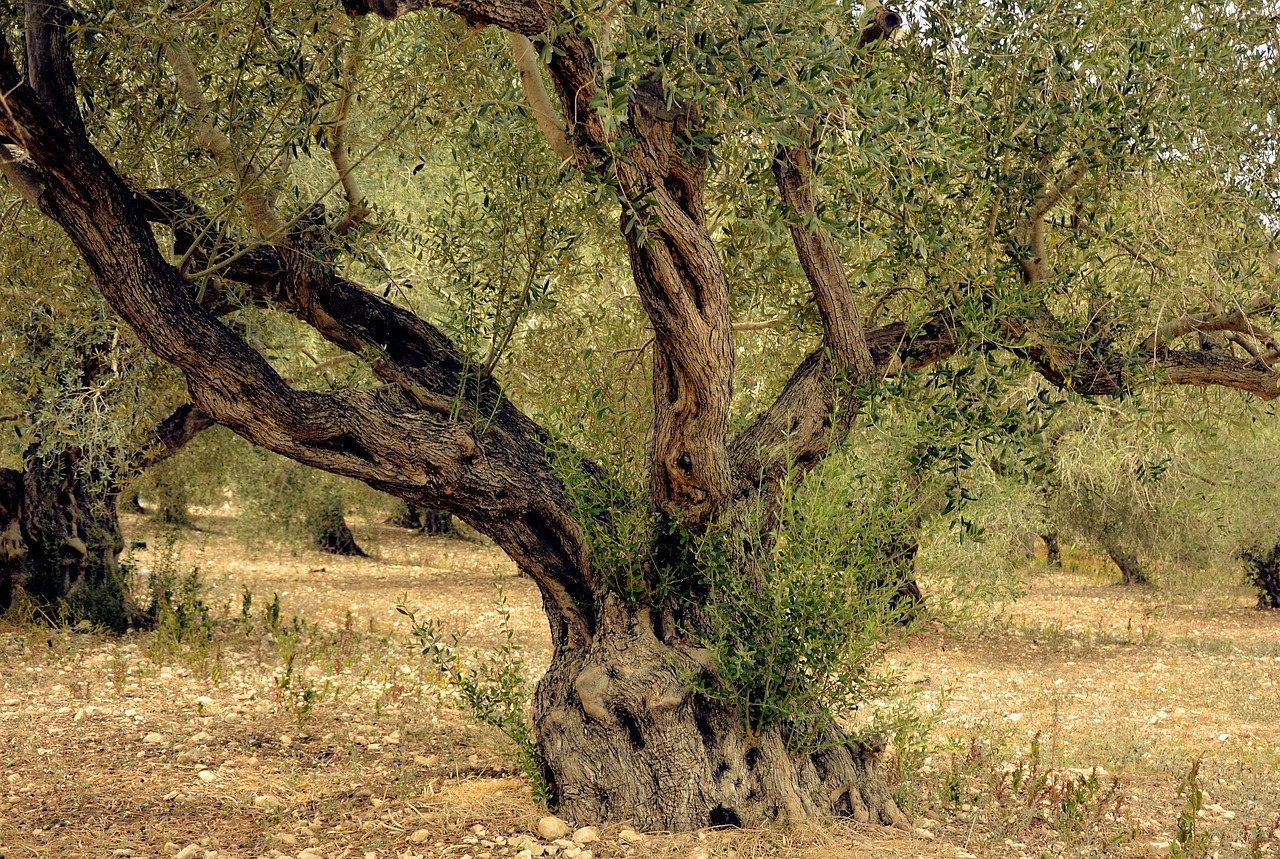
In modern Greece, monumental olive trees still stand in Crete, the Aegean and Ionian islands, the Peloponnese, Euboea, Chios, Pelion and Attica, some living for a thousand years or more, and they function today as more than agricultural curiosities. They are treated as genuine elements of Mediterranean natural and cultural heritage, symbols of continuity and communal memory precisely because they are still alive and still producing rather than simply preserved as ruins.
Why the symbol has outlasted every empire that used it
What is genuinely striking about olive symbolism, considered across its full span, is not any single use of it but its persistence across every political and religious system that has claimed the Mediterranean world. Greek city states used it, Rome adopted and extended it, three major world religions independently arrived at closely related meanings for it, and it survives today on flags, treaties and the emblem of the United Nations itself. Few symbols have proven this durable across this many unrelated systems of belief, and the durability itself is part of what the symbol has come to mean, a tree, and an idea, that has simply outlasted every empire that tried to claim it.
A symbol worth its longevity
The symbolism of the olive tree remains vivid because it has never had to be maintained artificially. Each tradition that adopted it did so because the tree’s own qualities, endurance, usefulness and quiet renewal after damage, matched what that tradition already wanted to say, and that is a rarer thing than it sounds. It is visible still in trees such as Crete’s Vouves olive, believed to be several thousand years old and producing fruit to this day, and it remains a working symbol rather than a historical footnote, most visibly at the centre of the United Nations emblem itself. That is why the symbol has outlasted every single power structure that has ever tried to claim it as its own.
For the founding myth itself, the eternal tree tells the fuller story, and for the economic and agricultural history that ran alongside this symbolic one, the history of the olive tree provides the complete account.