
Why Parents Plant Trees
There is a saying, attributed to a Canadian farmer named Nelson Henderson, that has circulated for decades without anyone being entirely sure where it came from. It goes like this: the true meaning of life is to plant trees under whose shade you do not expect to sit.
It is one of those sentences that people quote because it contains something true, something they recognise immediately, even if they could not have articulated it before. It describes a specific human impulse that is almost universally understood but rarely examined directly.
Why do parents plant trees for their children?
Not because children need trees. Not primarily for environmental reasons, though those are real. Not because trees are inexpensive or convenient or easy to maintain. Parents plant trees for their children because something in the act of planting, something in the specific gesture of putting a living thing into the ground for someone who is just beginning their life, satisfies a need that nothing else quite reaches. The need to say, in a form that will outlast words: I was here. I thought about your future. I gave something living to carry you forward.
This article is about that impulse. Not about horticulture. About what it actually means psychologically, emotionally, and in the deepest sense philosophically, when a parent gives a child something alive.
The Parent’s Relationship With Time Is Different From Anyone Else’s
Before you have children, your relationship with the future is relatively abstract. You think about it, you plan for it, you make decisions that account for it, but the future is primarily yours. It is the time your own life will occupy.
The moment a child arrives, the relationship with the future becomes entirely different. Suddenly there is a person in the world whose entire life lies ahead, a life you will only partially witness, that will extend decades beyond your own, that will be shaped in ways you cannot predict by forces you cannot control. And you love this person with a specific quality of love that is unlike anything else available to human experience, a love that is not contingent on what they do or become, that does not diminish when they are difficult or disappointing, and that points, almost involuntarily, toward their future rather than your own.
This shift in temporal orientation from a future that is yours to a future that is theirs, is at the heart of what the parental legacy impulse actually is. When parents give a child something alive, something that will grow alongside them and outlast the childhood that is still beginning, they are responding to this shift. They are giving physical form to the specific quality of love that parents feel, a love that is oriented toward a future the parent will not fully inhabit.
The psychology literature is precise about this mechanism. When individuals perceive nature as an extended self while facing the inherent finitude of life, transmitting this extended self to future generations becomes a primary way to maintain self-continuity and existential meaning. PMC A tree given to a child is, in this precise psychological sense, an extension of the parent’s self transmitted to the child’s future, a living thing that carries the parent’s love into years the parent may not see.
What the Tree Is Saying
Every culture in the world plants trees for children. Birth trees, memorial trees, anniversary trees, trees planted at the arrival of a grandchild. The practice predates written records in most of the cultures that have it. It is one of those human behaviours that is so widespread, so persistent across different languages and traditions and agricultural conditions, that it points toward something fundamental in human psychology rather than toward any particular cultural preference.
What is the tree actually saying? Not in words, not in anything that could be written on a card or spoken at a ceremony. In the specific language of a living thing planted in real soil and left to grow.
It is saying: I thought about you when I could not know you yet. I made a decision for your future before your future had begun. I gave you something that will still be here when the memory of this moment has passed, something that will grow as you grow, that will still be alive when you are grown, and that will carry, in its specific biological reality, the fact that someone who loved you put it there.
Trees become more than part of the landscape when they are planted for a purpose. They become part of the family story. The Trees Remember. The child who knows that the oak in the garden was planted by their grandparent, or that the ancient olive tree in Greece was dedicated to them at birth, carries something with them that no financial inheritance can replicate: the specific knowledge that someone who loved them thought seriously about their future, and gave it something living.
The Mycorrhizal Metaphor. What Trees Understand About Family
There is a metaphor that the psychologist who writes about intergenerational influence for Psychology Today reaches for when describing how families pass things between generations. It is the mycorrhizal network, the underground system of fungal connections through which trees in a healthy forest share water, nutrients, and chemical signals. The older trees support the younger ones. Information passes invisibly through the network. The forest is not simply a collection of individual trees. It is a living system of relationships, and the health of the whole depends on the quality of the connections between its parts.
In healthy forests, each tree is connected to others via a system enabling them to share water and nutrients. This is especially important for saplings, which must rely on the older, taller trees. Psychology Today
The family is like this. The parent who plants a tree for a child is not simply giving them an object. They are adding a living connection to the network; a specific, biological relationship between the child and the natural world that will carry the parent’s intention, their love, and their specific hope for this particular future, in the most physical and most enduring form available.
The Ancient Greek Olive Tree as the Parent’s Most Complete Expression
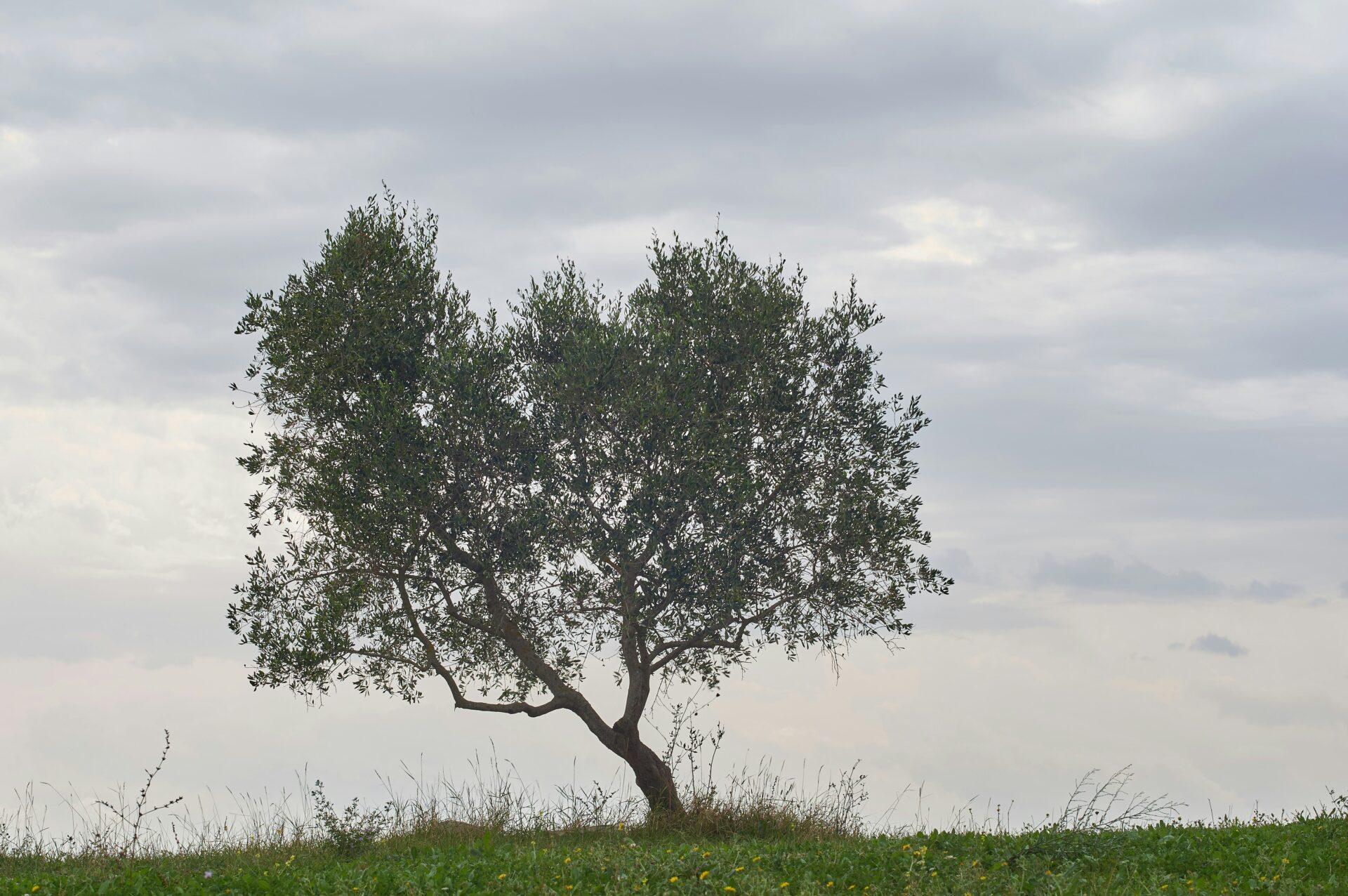
Of all the trees a parent might plant for a child, the ancient olive tree of Greece occupies a position that no other tree can quite match. Not because it is more beautiful, though the ancient olive is extraordinary in its gnarled, silver beauty. Not because it is more symbolic, though the olive carries more cultural and mythological significance than almost any other tree in the world.
But because it is the most complete expression of what the parental legacy impulse is actually seeking. It is the tree that was already ancient before anyone alive today was born. It is the tree that will still be producing when the child who receives it has grown, had their own children, and grown old. It is the tree that does not simply grow but produces, that gives something extraordinary from itself each year, labelled with the child’s name, arriving at the child’s table as annual evidence that the gift their parent gave them is still alive.
The parent who dedicates an ancient olive tree in Greece to a child at birth is not planting a tree in the conventional sense. They are connecting their child at the moment of their arrival into the world, to something that has already outlasted every other generation alive, and that will outlast this one too. The child who receives this at birth does not understand it yet. But the tree does not need to be understood to begin doing its work. It is already growing. It was growing before the child was born. And it will grow after them.
Legacy psychology explores the emotional and cognitive drive to create meaning that outlives us. Psychologists describe this as a form of symbolic immortality; the desire to know that one’s life energy will continue to influence others. This drive intensifies as people move through adulthood. Moodacity. The ancient olive tree dedicated to a child is symbolic immortality in its most literal, most biological, most genuinely non-symbolic form. It is not a symbol of continuity. It is continuity, alive, annual, specific, and growing.
What the Olive Oil Teaches a Child About the World
There is something that happens when a child is old enough to understand that there is an ancient tree in Greece with their name on it, and that the olive oil on the table came from that tree, this year, from this harvest.
It is not the same thing as being told they are loved. They know they are loved in a hundred ways by then through presence and attention and the ordinary daily work of parenting that rarely announces itself as significant.
This is different. This is the specific knowledge that before they were born, or at the very beginning of their life, someone thought seriously enough about their future to give it something alive. Something that produces from itself each year and will still be producing when they are old. Something that exists in a real place in Greece that they can visit, that has their name on a plaque, and that is tended by people who know it belongs to them.
That is a specific kind of knowledge. It is the knowledge that someone planted a tree under whose shade they are expected to sit, and that the tree is still growing.
Unlike material gifts that fade with time, trees grow stronger, more beautiful, and more impactful with age. A tree planted today will offer fruits and meaning to someone decades from now a grandchild not yet born. Bharatvarsh Nature Farms. The ancient olive tree given to a child at birth is a gift from a grandparent to grandchildren they may never meet, through the child who is the bridge between them.
That is why parents plant trees.
Not because of the shade. Because of the love that points toward a future they will not fully inhabit, that finds in a living ancient thing the only form adequate to what it is trying to express.
For the foundational account of what a living legacy is, the Living Legacy Guide provides the comprehensive framework. For the anthropological account of why every civilisation plants trees as expressions of the legacy impulse, Why We Leave Legacies provides the broader grounding. For those exploring what it means to give a living ancient thing as a gift that lasts beyond a lifetime, Gifts That Last Beyond a Lifetime examines the gifting dimension in depth.
To explore what dedicating an ancient olive tree for a child involves in practice, the Ownership page provides the full account. To begin a private conversation, the Contact page is your starting point.