
Why Founders Think About Legacy
There is a moment that almost every founder who has sold a company describes in almost exactly the same way. It does not happen on the day of the sale. It does not happen in the first weeks, when the calls are still coming in, when the lawyers and advisers and congratulations keep the calendar full and the sense of significance intact.
It happens later. Three months in, sometimes six. The morning when the phone does not ring before eight. The afternoon that has no meeting in it. The dinner where someone asks what you are working on and the honest answer is: nothing, for the first time in twenty years.
That is when the question arrives.
Not the financial question. The financial question was answered the day the wire cleared. The question that arrives later is different, and most founders are entirely unprepared for it.
Who am I without this? And what, if anything, am I building now?
The Thing Nobody Warns You About
The exit is supposed to be the climax of a founder’s journey. A successful sale, IPO, or merger signals triumph, validation of vision, hard work, and risk taken across years when the outcome was genuinely uncertain. Friends, investors, and the press celebrate. Everyone assumes the founder will bask in newfound wealth, freedom, and influence.
And yet the reality is often profoundly different. Founders who have sold their companies describe a sudden emptiness, an invisible void that no cheque or accolade can fill. The adrenaline that once defined their days, fundraising, product launches, hiring crises, vanishes overnight. The routines, responsibilities, and crises that once gave shape to the days are gone, leaving something that nobody had a word for and that most founders had no framework to navigate.
According to widely cited research from the Exit Planning Institute and PricewaterhouseCoopers, roughly 75 per cent of business owners report profound regret within a year of selling their company. And the Exit Planning Institute’s State of Owner Readiness Report found that only 44 per cent of owners felt they had planned enough, not for financial reasons, but for emotional ones. Entrepreneur
This is not a failure of financial planning. The financial plans, in most of these cases, worked exactly as designed. It is something else, something that the industry that surrounds founders through the building phase rarely prepares them for, because it lies outside the domain of finance, law, and strategy entirely.
It is the identity question. And it is, for most founders who encounter it, the most disorienting question of their adult lives.
What the Business Was Actually Providing
The business was not just providing income. It was providing something considerably more fundamental, something that the income was, in a sense, a byproduct of.
It was providing structure. The shape of the day, the week, the year, the meetings, the decisions, the problems to solve and the people to solve them alongside. Founders seldom consider what post-exit life will be like, other than to imagine leisure on tropical islands after shedding the quotidian responsibilities of working capital, inventory, employees, and all the other concerns that occupy the leader of a company. There is no time or space to think about what happens beyond the enticing exit, because the demands of running a business are often all-consuming. Yale School of Management
It was providing identity. A lot of entrepreneurs’ businesses are like their third or fourth child. So while the outside world sees an acquisition or a listing as the ultimate achievement, founders often face a more personal question: what comes next? Who am I without the business? How do I spend my time? What gives me purpose? Entrepreneur UK
And it was providing, though most founders would not have used this word while they were inside it, a sense of legacy in real time. The daily sense that what you were doing was building something, something that would outlast the immediate moment, that would still exist tomorrow and next year, that had a shape and a direction and a story that you were responsible for continuing.
When the business goes, all three go with it. And the person who was so thoroughly occupied with building something suddenly faces the most open and the most vertiginous question available: now what?
The Two Wrong Answers
Most founders, encountering this question for the first time, reach for one of two answers. Both are understandable. Neither is quite right.
The first is to start again. To find the next company, the next venture, the next problem worth solving. This works for some people. The builder who genuinely loves building, who finds the process of creating something from nothing to be its own reward, can do this indefinitely and find genuine satisfaction in it. But for a significant proportion of founders, the second venture reveals something the first did not, that what they were seeking was not the building itself but something the building provided, and that building again does not provide it in the same way.
The second wrong answer is the leisure answer, the islands, the boats, the golf courses. This also works for some people, for a time. But the founder who spent twenty years solving hard problems rarely finds that a life without hard problems is genuinely satisfying for long. Activity, as one adviser puts it, becomes a substitute for purpose. And an empty office with nothing to do but read the newspaper every day is rarely fulfilling for someone whose identity was built on being the person who made things happen. Forbes Business Council
The question that both answers are trying to avoid is the same question that the exit made unavoidable: not what to do next, but what to build, not financially, not structurally, but in the deepest sense of building something that will still be here when you are not.
The Legacy Question, Properly Understood
Wealth is financial. Legacy is relational, emotional, and deeply personal. The happiest founders are not necessarily the richest. They are the ones who have clarity about what matters beyond the business itself, family relationships, mentoring others, creating something with lasting cultural or social impact, and having a clear sense of their own values. Forbes Business Council
The legacy question, properly understood, is not the question of what you will be remembered for. That is a version of the question, but it is a relatively shallow version, oriented toward reputation rather than toward meaning. The deeper version of the question is what a founder at Innocent Drinks identified when describing what the company was for: we wanted to work for ourselves and create a great work environment, have fun, and if we can create something of lasting value, great. I’m not saying money doesn’t matter, but it’s not the most important thing. Julius Baer
What founders are actually asking, when the legacy question arrives, is not how to be remembered. It is what to hold. What to be genuinely responsible for. What to give genuine attention to, in the years that have opened up, that will still matter when the attention has passed.
This is a different question from the one the financial planning addresses. It cannot be answered by a portfolio allocation or an estate structure or a governance framework. It can only be answered by finding something alive, something that requires the specific quality of engaged attention that building requires, that rewards that attention with a quality of satisfaction that financial instruments alone cannot produce, and that will still be here after the founder is gone.
What an Ancient Greek Olive Tree Gives a Founder That a Second Company Does Not
The search for purpose and legacy among entrepreneurs is now a growing trend. Increasingly, a sense of purpose is a significant factor. Founders want to make their mark on the world in a positive way. Julius Baer
But the mark that most founders are actually seeking is not the mark of another commercial venture. It is something quieter, more personal, and more enduring, something that exists not in market share or revenue but in a specific place, a specific living thing, and the specific annual evidence that something they established is still growing.
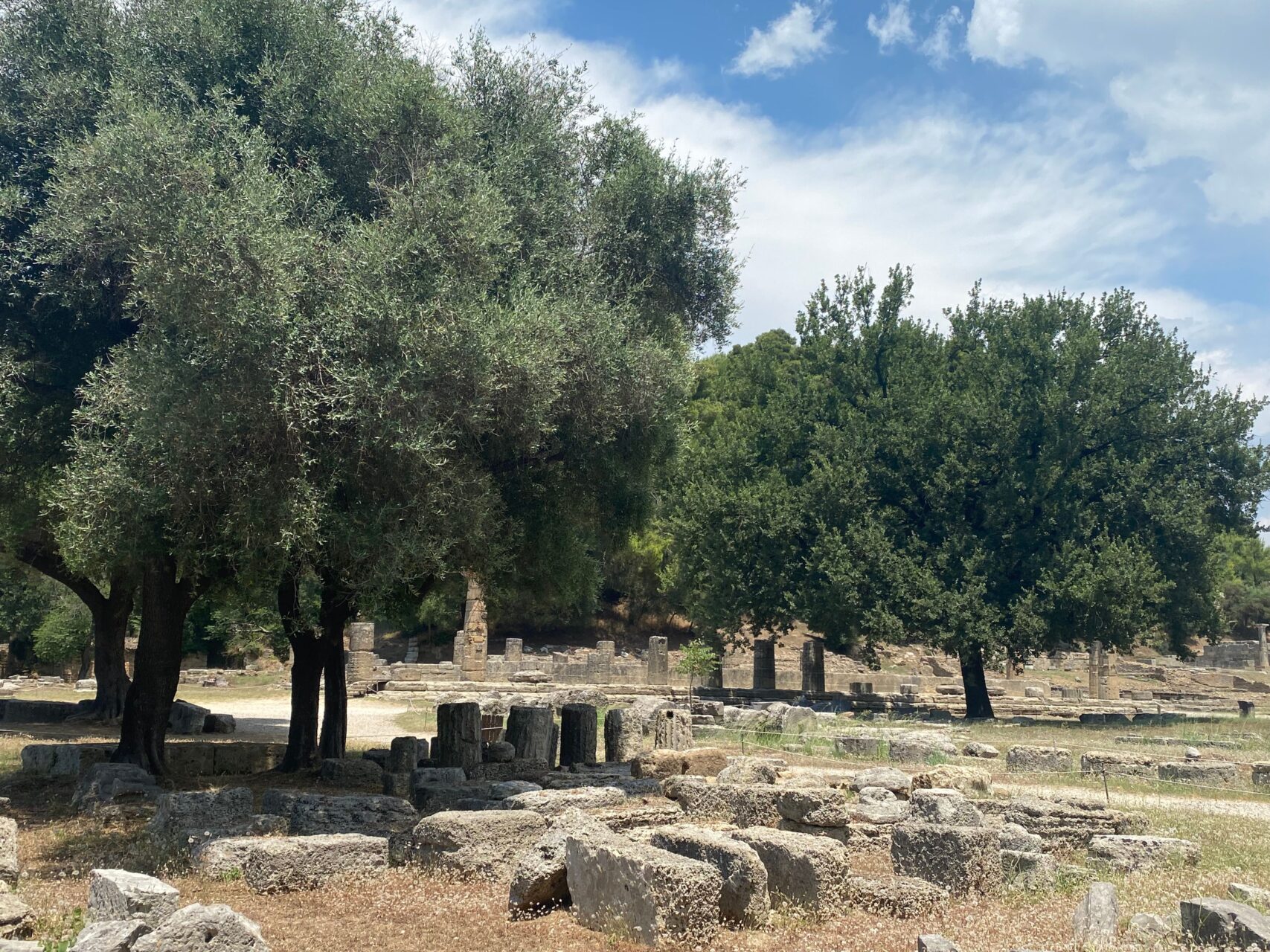
An ancient olive tree in a historic Greek grove offers a founder something that a second company cannot. It does not require the founder to build again, to recruit, to fundraise, to manage, to compete. It requires something different and in many ways more demanding: the willingness to be genuinely responsible for something alive, to pay attention to it across seasons and years, and to find satisfaction in the specific quality of what it produces rather than in the scale of what it achieves.
The olive oil that arrives each autumn from a specific tree in a specific Greek grove is not a commercial product. It is the annual evidence that something the founder established is continuing, growing, producing, deepening in character with each passing year. It is the living proof that the legacy question, which arrived so suddenly and so unexpectedly the morning the phone stopped ringing, has been answered with something real.
The tree does not care about the founder’s previous valuation. It does not respond to urgency or ambition or competitive pressure. It grows at its own pace, on its own timescale, and it produces something extraordinary each year from the specific quality of the soil and the season and the care it receives. The founder who holds it is responsible for ensuring that it is tended well, and the olive oil that arrives is the honest, annual assessment of how well that responsibility has been honoured.
That is a different kind of accountability from anything a business provides. And for the founder who has spent decades being accountable to investors, customers, and employees, it turns out to be, for reasons that are not immediately obvious but become clear after the first harvest arrives, exactly the kind of accountability that makes the post-exit years feel like something has been rebuilt rather than something has been lost.
For the foundational account of what a living legacy is and why it answers the question that the exit makes unavoidable, the Living Legacy Guide provides the comprehensive framework. For the distinction between wealth and legacy that is at the heart of the founder’s post-exit question, The Difference Between Wealth and Legacy examines it in depth. For the anthropological account of why the legacy impulse, the drive to build something that outlasts the builder, is a fundamental feature of human psychology rather than a luxury of later life, Why We Leave Legacies provides the deeper grounding.
The Question Is Already Here
The founder reading this who has not yet exited is probably not thinking about the legacy question. They are thinking about the next round, the next hire, the next product milestone. The founder who has recently exited knows exactly what the question feels like when it arrives.
Both are worth knowing this: the legacy question is not a question for later. It is a question worth considering before the exit arrives, so that when it does, when the morning comes with nothing in the calendar and the sense of significance fades before the sense of direction has replaced it, there is already something alive and waiting. Something that has been growing for centuries in a grove in Greece, accumulating the character of each passing year, ready to receive the quality of attention that the builder was always capable of bringing and that has now, for the first time, nowhere obvious to go.
To explore what stewardship of an ancient Greek olive tree involves in practice, the Ownership page provides the full account. To begin a private conversation, start with the Contact page.