
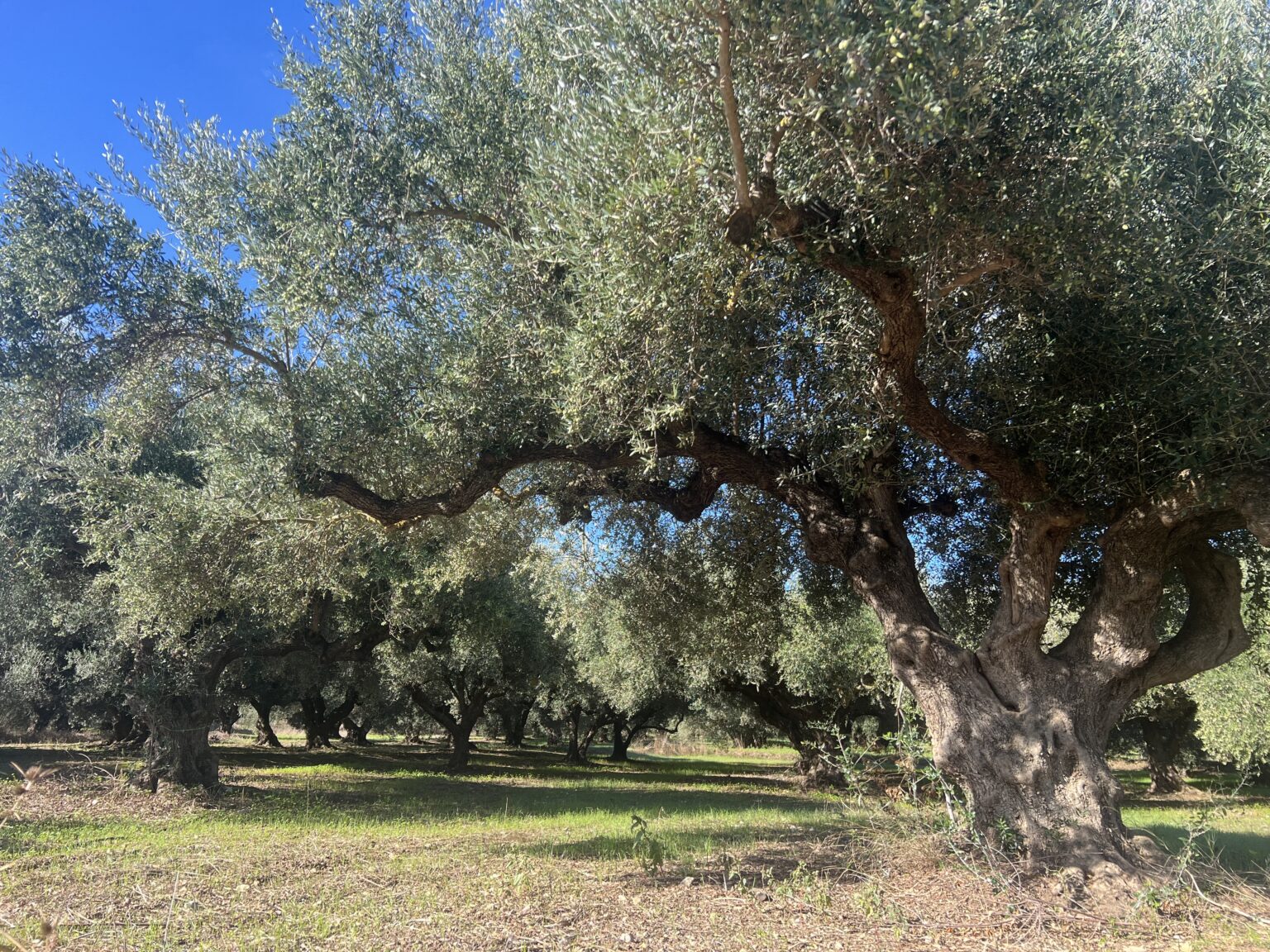
How Long Do Olive Trees Live? Why Some Seem Immortal
An olive tree commonly lives for several hundred years, and a small number are believed to be far older than a thousand. The reason is not that the olive is unusually tough. It is that the olive keeps renewing itself. When the trunk is burned, frozen, split or cut down, the tree can send up new shoots from its roots and from the base of the trunk, and carry on growing as though the damage were simply one more season. That habit of renewal is what makes some olive trees seem immortal, and it is also why the age of the oldest ones is so hard to pin down.
How Long Do Olive Trees Live?
Most olive trees live far longer than the people who plant them. A well placed tree in reasonable soil will normally go on fruiting for centuries, and many of the trees still harvested across Greece were already old when their present owners’ grandparents were children. The working life of a commercial grove is often shorter, because growers replant when yields fall or when they change how they farm, but that is a decision about the grove, not a limit set by the tree.
What makes the olive different is that it has no fixed end point in the way that many trees do. A tree that is felled, or killed above ground by fire or a hard frost, is not necessarily finished. Below the surface, the roots and the swollen base of the trunk are often still alive, and they are capable of starting again.
Are Olive Trees Immortal?
No olive tree is truly immortal, but the olive comes closer than almost any tree we cultivate. Its secret is that it does not depend on a single trunk to survive. At the base of an olive tree, where the trunk meets the roots, the wood forms knotted swellings full of dormant buds. Italian growers call these ovoli and have used them for centuries to raise new trees. When the trunk above is damaged or dies, these buds can wake and grow into new stems, fed by a root system that may already be very old.
A tree that renews itself this way is, in a sense, the same living organism for as long as its roots survive, even if the wood you can see is much younger than the plant it belongs to. This is why it is possible to stand in front of an olive tree whose visible trunk is a few centuries old and still be looking at something that began far earlier.
Why Olive Trees Regrow After Fire and Frost?
The olive’s ability to recover is not a legend, although Greece has one. After the Persians burned Athens in 480 BC, the sacred olive on the Acropolis was said to have put out a new shoot from its blackened stump within a day, a story told more fully in The Eternal Tree.
The same thing happens today, and it is recorded. After wildfires swept western Sardinia in 2021, a wild olive at Sa Tanca Manna, near Cuglieri, believed to be around a thousand years old, was left as a charred stump. The following spring, researchers from the University of Cagliari found living tissue in parts of the stump, and new shoots appeared at its base, as reported by Olive Oil Times. Growers who lose trees to frost see the same pattern: the branches die back, and new growth rises from the base once the weather turns.
The Hollow Trunk That Keeps Living
The second reason olive trees last so long is the way their trunks age. As an olive grows very old, the wood at the centre slowly decays and disappears, and the trunk hollows, splits and divides. To the eye this looks like decline. In fact the living part of any trunk is a thin layer just beneath the bark, and that layer goes on growing around the edges of what remains.
Over the centuries, an ancient olive often separates into several sections, each with its own share of roots and its own share of the canopy. If one section fails, the others carry on. The tree becomes less a single column than a small community of stems sharing one root system, which is part of what gives the oldest olives their sculptural, almost geological shape. What that looks like in a tree of great age is described in What Does a 2500 Year Old Olive Tree Look Like.
Do Olive Trees Have Deep Roots?
Olive trees have wide roots rather than very deep ones. According to the Food and Agriculture Organization of the United Nations, most of the water an olive takes up comes from the first 1.2 to 1.7 metres of soil, while its lateral roots can spread up to twelve metres from the trunk. In heavy, poorly drained ground the roots stay close to the surface, and in light, open soils they go deeper.
That broad, shallow network suits a tree from a dry climate. It lets the olive collect what little rain falls across a large area, and it holds the soil on the terraced hillsides where so many Greek groves grow. It is also the store of life that makes regrowth possible. As long as the roots remain healthy, the tree has a reserve to draw on when everything above ground has been lost.
Slow Growth and a Hard Life
It may seem strange, but the olive trees that live longest are often the ones that have had the hardest lives. On poor, dry, rocky ground the tree grows slowly, adding very little wood each year. Slow growth makes dense wood, and a tree that has spent centuries growing slowly on a harsh slope is often better able to survive than one that grew quickly in rich soil.
The olive is also built for drought. Its narrow, silvery leaves lose little water, and in a dry summer the tree can almost stop growing until the rain returns. Researchers who dated the Noah olive trees of Lebanon in 2024 reached a conclusion that points the same way: the oldest olive trees are most likely to be found on harsh sites, where growth is slow.
What Is the Oldest Olive Tree in the World?
The oldest olive tree that science has dated so far is one of the Noah olive trees of Bshaaleh, in northern Lebanon, which radiocarbon dating published in 2024 placed at around 1,160 years. The same researchers suggested that many olive trees described as more than a thousand years old are likely to be several centuries old instead. Other specialists disagree, partly because radiocarbon dating can only date the wood that survives, and in a hollow trunk the oldest wood is precisely what has gone.
Greece is home to several of the most celebrated contenders. The Monumental Olive Tree of Vouves, in western Crete, has a trunk circumference of around 12.5 metres and is estimated to be between two and four thousand years old. The olive tree of Kavousi, in eastern Crete, has been estimated at around 3,250 years. Both figures are estimates drawn from the size of the trunk and an assumed rate of growth, not laboratory dates, and they should be read that way. How those estimates are made, and why they can differ so widely, is explained in How to Tell the Age of an Olive Tree.
Where the Oldest Olive Trees in Greece Grow?
The oldest olive trees in Greece grow in the country’s long established olive regions, and the registry of ancient trees kept by Olea Legacy spans five of them: Crete, the Peloponnese, Halkidiki, the Aegean Islands and the Ionian Islands. According to Yiannis Karapiperis, founder of Olea Legacy, every tree in the registry is a living tree still tended by its growers, and every steward is welcome to visit their tree throughout the year by prior arrangement, a commitment written into Olea Legacy’s stewardship model.
These are not museum pieces fenced off from the life around them. They are working trees, still flowering in spring and still bearing fruit in autumn, in groves where families have picked olives for generations. Their great age is not something preserved behind glass. It is visible in every twisted trunk, and it continues each year.
A Tree That Will Outlast Its Owner
There is something quietly unusual about holding a living thing that will almost certainly outlive you. An ancient olive tree has already outlasted every person who has tended it, and if its roots stay healthy, it will go on long after the present generation has gone. The question of who looks after it next is part of what makes it meaningful.
That is the idea behind Olea Legacy. Through Ownership, a person can become the steward of a specific ancient olive tree in Greece, recorded in their name, harvested each year, and passed on in time to the people who come after them. Why such a tree is regarded as an asset of a different kind is explored in Ancient Olive Trees as a Legacy Asset, and the wider thinking is set out in the Living Legacy Guide.
The olive tree has spent thousands of years showing that an ending is not always final. For anyone who wants to leave something that lasts, there are few better teachers.