
Why Certain Places Become Part of Who We Are
There are places you visit and places you inhabit. The difference is not a matter of time spent, though time matters. It is a matter of what happens between the person and the place over the course of that time. Whether the place remains an environment you move through, or whether it becomes something more fundamental than that. Something that starts to constitute who you are rather than simply where you have been.
This distinction is psychological. It has been studied carefully and documented precisely by environmental psychologists, social scientists, and neuroscientists for more than three decades. And what the research reveals has profound implications for anyone thinking seriously about what they hold, what they return to, and what they eventually pass forward.
The field is called place attachment. And it may be the most important concept that the luxury world has not yet discovered.
What Place Attachment Actually Is
Place attachment is the emotional bond an individual forms with a specific location. It is not simply the pleasure of being somewhere beautiful, or the satisfaction of returning to somewhere familiar. It is a deeper and more constitutive relationship than either of those, one in which the place becomes integrated into the person’s sense of self, their continuous experience of who they are across time, and their psychological experience of stability and belonging in the world.
Researchers in the field have organised the concept into a tripartite framework consisting of three dimensions: the person, the place, and the process. Individuals use specific places in establishing their uniqueness, maintaining continuity in time, and building self-esteem and self-efficacy. The places most likely to inform self-concept include workplaces, residences, recreational settings, and the communities surrounding them. EBSCO Research Starters
But this framework was developed primarily in the context of urban and suburban environments, homes, neighbourhoods, cities. What the research has not yet examined in any systematic way is the specific form of place attachment that develops between a person and an ancient agricultural landscape, a grove, a vineyard, an orchard that has been continuously cultivated for centuries and that is still alive and productive when the person first encounters it.
This is a different kind of place attachment from anything the urban research has mapped. And it operates through mechanisms that are, in several important respects, more powerful than any the existing research has described.
The Three Channels Through Which We Bond with Places
Environmental psychology has identified three distinct channels through which place attachment forms and deepens. Understanding them clarifies why certain places become part of who we are while others remain permanently external, beautiful, perhaps, or memorable, but never truly ours.
The cognitive channel, meaning and story
The first channel is cognitive. We attach to places that carry meaning, places whose story intersects with our own, that hold memories of significant experiences, that represent something we value or aspire to. The place meanings, or symbolic values and qualitative assessments, that an individual assigns to a given location are influenced by personal experiences with the place and its features as well as by sociocultural perspectives inherited from familial or communal collective memory. EBSCO Research Starters
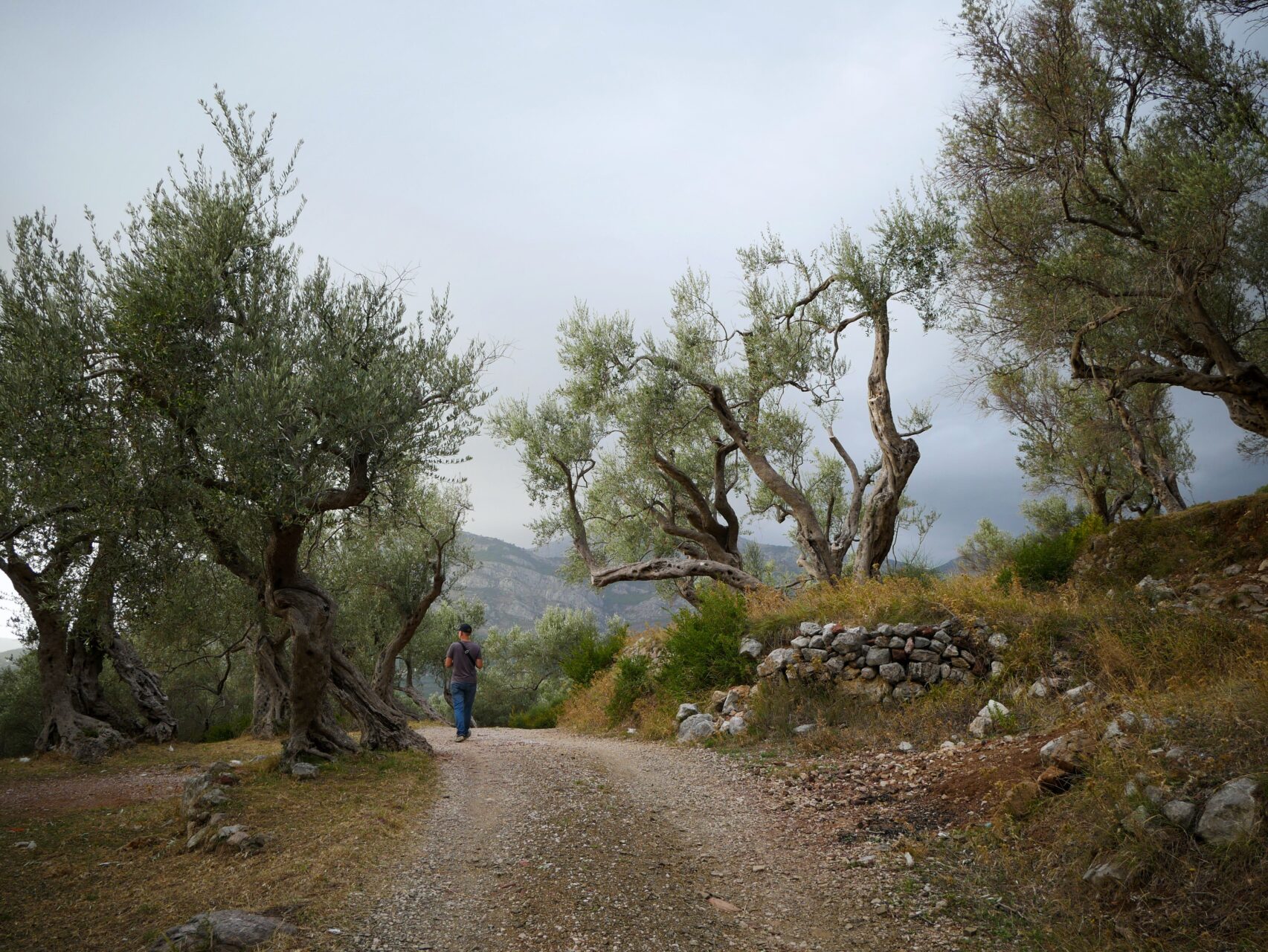
An ancient olive grove in Greece carries cognitive meaning of unusual depth. It is not simply a beautiful agricultural landscape though it is that. It is a place whose story extends back centuries, whose trees have lived through the rise and fall of empires, whose soil has been worked by people whose relationship with it extended across generations. The person who first encounters such a grove does not arrive at a neutral environment. They arrive at a place already dense with story, and the cognitive channel begins working immediately, connecting that story to whatever meaning the person brings with them.
The affective channel, emotion and sensory experience
The second channel is affective. We attach to places through the emotional and sensory experiences they produce, the specific quality of light, the texture of the bark under the hand, the smell of the soil after rain, the weight of the fruit in the palm before harvest. Research consistently shows that people feel more comfortable and less stressed in environments that resemble the landscapes of their childhood, and that the quality of sensory experience matters as much as the quantity of time spent in a place. Psychology Town
But there is a specific quality of the sensory experience in an ancient olive grove that the general research does not capture. It is the experience of being surrounded by living things that are older than any person currently alive, trees that were producing fruit when your grandparents’ grandparents were children. The specific emotion this produces is not simply pleasure or aesthetic appreciation. It is something closer to awe, the particular emotional response to encountering something that dwarfs the individual life in scale and continuity. And awe, the psychological research confirms, produces some of the most durable and identity-constituting experiences available to human beings.
The procedural channel, the body remembers
The third channel is the one that the research has most recently begun to document, and it is in many respects the most powerful. It is procedural, held in the body rather than in conscious memory.
Environmental psychologists have observed that our knowledge of deeply familiar places is procedural as much as declarative, held in the hands and the body, beneath conscious recall. The body keeps attending until the place becomes part of its operating assumptions. And people who relocate often reconstruct elements of a lost place in a new one, the same plants on a different windowsill, the same orientation of furniture toward the light, a neighbourhood chosen because something in it rhymes with somewhere else. Dr Katie Blake
This is what happens when a person visits their olive grove in Greece more than once. The second visit is not the same as the first, not because the grove has changed substantially, but because the body has retained something from the first encounter, a proprioceptive memory of the specific quality of the ground underfoot, the specific angle of the light at harvest time, the specific weight of the branches as they bend toward the picking hand. The grove is becoming part of the body’s operating assumptions. It is beginning to feel, in the most literal sense, like somewhere that belongs to the person in a way that extends beyond legal title.
Why Time Deepens the Bond, and Why Ancient Places Accelerate It
The research on how place attachment develops across time reveals a pattern that has direct implications for anyone considering stewardship of an ancient landscape.
Research on long-term residents found that people who had lived in an area for fewer than fifteen years were more likely to describe their connection in terms of natural features and scenery, while longer-term residents described it in terms of social and community bonds. Duration of stay significantly influences whether attachment and identity develop, a person spending three months somewhere may enjoy it but is unlikely to develop the layered bond that comes from years of accumulated experience. ScienceInsights
But there is a dimension of time that this research does not account for; the time embedded in the place itself. An ancient Greek olive tree does not require the steward to have known it for decades before it begins operating as an anchor for identity. It arrives pre-loaded with temporal depth. The steward does not need to have been present for the centuries the tree has been growing. The tree carries that time within it in the rings of its trunk, in the depth of its roots, in the specific character of the oil it produces from soil that has been building complexity for generations.
This is why attachment to an ancient Greek olive grove develops differently from attachment to a new environment. The person does not need to create the sense of depth; the depth is already there, embedded in the living thing itself. What the person adds, over time, is their own layer, their own visits, their own harvests, their own accumulated sensory memory of this specific place at specific seasons. And each layer they add does not simply sit on top of the ancient depth. It becomes part of it.
Place Identity When the Place Becomes Part of the Self
The most advanced form of place attachment is what researchers call place identity, the degree to which a place informs a person’s sense of self. Place identity occurs when a physical environment becomes part of a person’s self-concept, when someone describes themselves as a mountain person or a city person, the landscape has merged with their sense of who they are. Psychology Town
Place identity is not simply attachment deepened by time. It is a qualitative shift in the relationship between person and place; the point at which the place is no longer something external to the person but something constitutive of them. When this happens, the loss of the place is not experienced as the loss of something enjoyed or valued. It is experienced as a loss of part of the self.
This is the psychological reality behind the observation that certain families return to the same vineyard, generation after generation, even when the financial logic of doing so is unclear. That certain individuals feel drawn to specific landscapes with an urgency that they themselves find difficult to explain. That the person who has stood beside their olive tree in Greece three times over ten years finds, on the fourth visit, that they are not returning to somewhere they love, they are returning to somewhere they are.
Research by Maria Lewicka and others links this kind of deep place bond to belonging, life satisfaction, and a stable, continuous sense of self. The social dimension of place attachment deepens over time in a specific way, what begins as attraction to natural features and scenery deepens into something that is inseparable from community, from relationship, from the specific people and practices embedded in that place. Dr Katie Blake
In an ancient Greek olive grove, this deepening is accelerated by the specific social reality of the grove itself. The steward’s relationship with the place is not a relationship with an empty landscape. It is a relationship with the people who tend it, the growers whose knowledge of these specific trees extends across their own lifetimes and their parents’ lifetimes. The place comes populated with relationship, and relationship is, the research confirms, the strongest anchor of place identity available.
Topophilia. The Love of Place That Shapes Who We Become
The philosopher and geographer Yi-Fu Tuan coined the term topophilia (from the Greek words topos=place & philia=friendship) in 1974 to describe the affective bond between people and place, the love of specific places that shapes identity, memory, and the deepest sense of who one is in the world. The concept captures something that the more clinical language of place attachment psychology sometimes misses, the specifically loving quality of the deepest human relationships with places.
Topophilia is what people are describing when they say that a particular place has always felt like home even on the first visit. What they are experiencing is the recognition of a landscape that corresponds to something already present in them, an affinity that precedes conscious knowledge and that deepens, with time and attention, into something inseparable from the self.
Research into what triggers topophilia has identified four environmental qualities that consistently produce it: sensory richness, the presence of living things, the evidence of human care across time, and the sense of belonging to a community that exists within and around the place. ScienceInsights
An ancient olive grove in Greece satisfies all four conditions simultaneously and completely. The sensory richness of the landscape, the specific quality of Mediterranean light, the texture of ancient bark, the smell of fresh olive oil at harvest, is extraordinary by any measure. The presence of living things that are centuries old creates a specific kind of awe that few other environments can match. The evidence of human care across time is written into every aspect of the landscape, the terracing, the pruning, the specific spatial arrangement of trees that reflects generations of cultivation knowledge. And the community that exists within and around the grove, the growers, the local families, the tradition of harvest that has been practised in this specific place for centuries, is precisely the kind of social anchor that transforms attraction into belonging.
Why This Matters for Anyone Holding Something Ancient
The implications of place attachment research for anyone considering stewardship of an ancient olive grove are specific and significant.
What the research confirms is that the relationship between a person and an ancient place of the kind Olea Legacy offers is not primarily a financial relationship, or even primarily an aesthetic one. It is a psychological relationship that, over time, becomes constitutive of the person’s sense of who they are.
The first visit to the grove is the beginning of a cognitive, affective, and procedural process that, if honoured with time and attention, will eventually produce something the research can only describe in the language of identity. The person who has stood beside their tree in Greece across ten harvests does not simply know the place. They have become, in a precise psychological sense, partially constituted by it. The place is in them procedurally, affectively, cognitively, in a way that does not diminish when they return to London or Zurich or New York.
This is why the oil that arrives each autumn matters beyond its considerable quality as a product. It is a sensory encounter with a specific place, the smell and taste and texture of a particular grove in a particular year, carried across the distance between Greece and wherever the steward is living. It is, in the language of place attachment research, a form of proximity-seeking behaviour, the instinct to maintain connection with an attachment figure even across physical separation. The bottle is, in this precise sense, the grove arriving at the table.
And this is why the stewardship that Olea Legacy offers is not simply a luxury holding or a cultural experience. It is the beginning of a relationship with a specific place that, over time, will become part of who the steward is. The tree does not simply belong to them. They begin, gradually and irreversibly, to belong to it.
For the foundational account of what a living legacy is and why it matters now, the Living Legacy Guide provides the comprehensive framework. For the concept of experiential stewardship, the condition of holding a living place in such a way that the act of holding it is itself a continuous, deepening experience, What Is Experiential Ownership? examines the concept in depth. For those exploring the specific regions of Greece where Olea Legacy’s ancient trees are stewarded, The Olive Growing Regions of Greece provides the geographic and terroir account.
The Question the Research Is Really Answering
The question that place attachment research is ultimately answering is not a scientific one. It is a philosophical one: what does it mean to belong somewhere?
The answer the research provides is both precise and profound. It means that over time, through the accumulation of sensory experience, emotional association, and relational connection, a place stops being external to you and starts being internal. It stops being somewhere you go and starts being part of what you are. The boundary between self and place becomes, gradually and irreversibly, permeable.
The ancient olive groves of Greece are among the few places in the world where this process of becoming can be experienced in its most complete form. The depth of time embedded in the living trees, the richness of the sensory landscape, the social reality of the community that exists within and around the grove, and the annual return of the harvest, these are the precise conditions that the research identifies as most conducive to the deepest form of place attachment available to human beings.
The question worth asking, before the harvest season comes and goes again, is not whether this is a place worth visiting. It is whether this is a place you are ready to belong to.
To explore what stewardship of an ancient Greek olive tree involves in practice, the Ownership page provides the full account. To begin a private conversation, reach the Contact page.