
What It Means to Own Something That Can Never Be Made Again
There is a category of ownership that does not depend on rarity as a marketing decision.
Not a limited edition where the limit was chosen. Not a numbered run where the number could have been larger. Not a waiting list designed to create the impression of scarcity where none naturally exists.
Something else. Something where the impossibility of reproduction is not a commercial strategy but a simple fact.
That category is rarer than it sounds.
The Difference Between Manufactured Scarcity and Irreproducible Fact
Most luxury goods operate on manufactured scarcity. The decision to produce fewer units than demand would support is deliberate. It protects the price. It maintains the perception of exclusivity. It is a business model dressed as a constraint.
This is a description of how the category works, and it works well. But it is worth being precise about what is actually being offered.
Manufactured scarcity means that in principle, more could be made. The moulds exist. The materials can be sourced. The craftspeople are available. The decision not to produce more is a choice, and choices can be revisited.
Irreproducible fact means that more cannot be made, not because someone decided not to, but because the thing that made this particular object possible no longer exists in the same form. The moment has passed. The conditions that produced it are gone. The source has moved on.
What Makes a Harvest Irreproducible
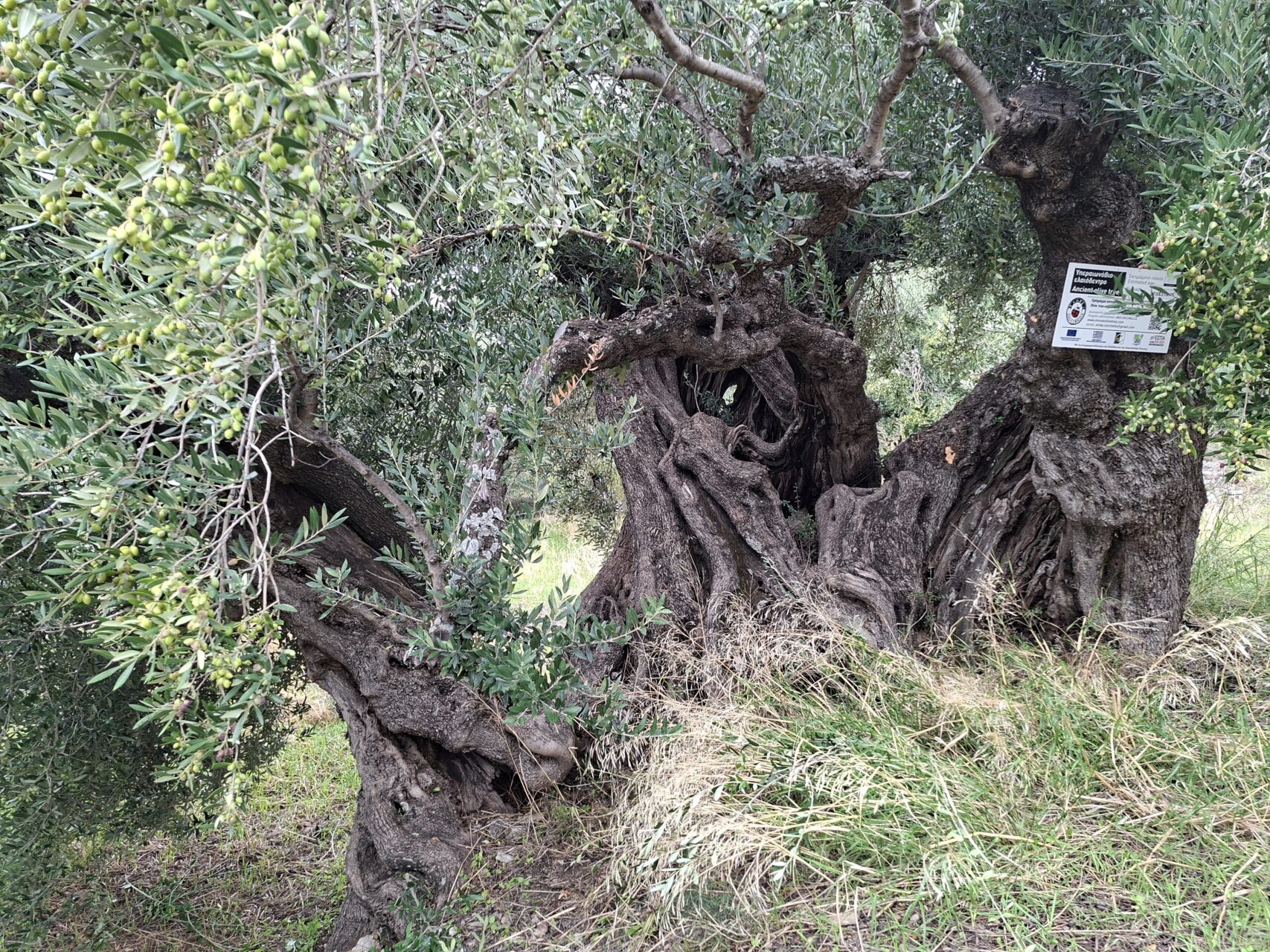
An olive tree that has been growing for approximately twenty-five centuries does not produce the same harvest twice.
Each year’s yield is shaped by the specific conditions of that year: the rainfall in the months before flowering, the temperature during the critical weeks, the precise stage of ripeness at which the olives were gathered. These conditions are never repeated exactly. The olive oil pressed from this November is not the same oil that would have been pressed last November, or that will be pressed next November, even from the same tree.
But the AION harvest goes further than this.
The November 2026 harvest from this tree will produce twenty collector editions. There is no second pressing. There is no reserve allocation. There is no batch held back for a later release. The tree produced what it produced, and what it produced becomes twenty editions. The harvest does not happen again in this form because the moment in which it happened, this tree, this season, this particular point in a twenty-five century life, is already behind us.
Next year, the tree will produce another harvest. That oil will be different because the year will be different, because the tree will be a year older, because the conditions will be what they are. But it will not be this. The AION edition is the oil from this specific convergence of factors, pressed once and made available in twenty numbered editions.
That is irreproducible fact.
Why Ownership of This Kind Is a Different Transaction
When you buy a luxury object produced in a limited run, you are buying into a category. The watch, the bag, the bottle from a celebrated vintage: you own one of a finite number of examples of a type. Your example is identical or near-identical to the others. The type is what has value, and your ownership is of an instance of that type.
When you acquire something that cannot be made again, the logic shifts.
You are not acquiring an instance of a type. You are acquiring the thing itself, one of a fixed number that exist because existence was determined by something other than a commercial decision. Your edition is numbered not because a number was assigned to it but because the yield of one ancient tree in one November produced exactly that many, and yours is one of them.
The object is not a representation of something valuable. It is the thing, carrying the specific conditions of its origin in material form.
What Remains When Everything Else Can Be Replicated
Replication has become the default condition of contemporary production. Anything that can be made can be made again, usually more efficiently and at lower cost. The materials can be sourced. The process can be documented. The result can be repeated.
What survives this logic intact is a small category of things whose origin cannot be replicated because the origin was a specific moment in time, a specific living thing, a specific set of conditions that no production process can reconstruct.
Ancient trees are in this category. Not because they are old, though age is part of what makes them what they are. But because a tree of this age carries a biological and historical specificity that has no equivalent. Its root system has spent twenty-five centuries developing a relationship with one piece of ground. Its oil reflects that relationship. And the harvest from any given year of its life reflects the conditions of that year, against the background of everything that preceded it.
You cannot replicate that by sourcing older trees. There are no older trees available for this purpose. You cannot replicate it by using the same tree next year, because next year is not this year. The convergence of factors that produces this edition is, by definition, a convergence that happens once.
What the AION Edition Represents in This Context
The AION by Olea Legacy collector edition draws its oil from one ancient tree in eastern Crete, in one November harvest, made available in twenty individually numbered editions.
The full story of the tree, including its documentation, its certification and its precise location, will be disclosed at the December 2026 reveal. What is available now is this: the tree exists, it has been formally identified, its age has been assessed, and its November 2026 harvest has been pressed and allocated to twenty editions that will not be followed by a second batch.
For a full account of what a tree of this age actually looks like and what it means that it is still producing, What Does a 2500 Year Old Olive Tree Look Like? covers the detail.
Everything currently available about AION, including how to register interest before the December reveal, is on the AION by Olea Legacy page.